
Childhood trauma in Muslim adults is one of the most quietly carried burdens in the community. Many Muslim adults grew up in homes where love was real but the environment was painful, where parents did their best but their best still left wounds. And for years, perhaps decades, those wounds have gone unnamed.
At Salam Space, we work with Muslim adults every day who are only just beginning to understand that what happened to them as children was not normal, not deserved, and not something they simply have to live with forever. This post is for them, and for anyone who has ever wondered whether it is possible to heal without feeling like they are betraying the people who raised them.
What Childhood Trauma Actually Looks Like in Muslim Families
Childhood trauma in Muslim adults rarely looks like what people imagine when they hear the word trauma. It is not always dramatic. It is not always a single catastrophic event. More often, it is a pattern, something that happened over and over again, so consistently that it began to feel normal.
In Muslim families, childhood trauma frequently takes these forms:
Emotional unavailability. A parent who was physically present but emotionally absent. Who never said “I love you.” Who did not know how to sit with their child's sadness. Who responded to vulnerability with dismissal or silence. This is not dramatic, but its effects are profound.
Verbal and emotional abuse. Being told you were useless, stupid, a disappointment, or an embarrassment. Being compared constantly to siblings or cousins. Being shamed for academic performance, weight, appearance, or personality. These words land in a child's developing mind and set up camp there for decades.
Physical punishment framed as discipline. Many Muslim adults grew up being hit, not because their parents were cruel, but because their parents genuinely believed this was an acceptable and even necessary part of raising children. The intention does not erase the impact.
Neglect. Not having emotional needs acknowledged or met. Being left to manage fear, confusion, and pain alone because asking for comfort was seen as weakness or inconvenience.
Witnessing domestic conflict or violence. Growing up in a home where parents fought loudly, regularly, or sometimes physically. Even if the child was never directly harmed, witnessing this creates its own form of trauma.
Religious or spiritual abuse. Having faith weaponised against you. Being told that your struggles were punishment from Allah, that asking questions was haram, or that your worth as a person was tied entirely to your religious performance.
When Discipline Becomes Damage
One of the most painful conversations in Muslim mental health is the line between discipline and abuse, because in many Muslim communities, that line has been drawn in entirely the wrong place.
The Prophet (peace be upon him) never struck a child. He was known for his extraordinary gentleness with children, for getting down to their level, for being playful, patient, and tender. His model of parenting was rooted in mercy and connection. Yet in many Muslim homes, practices that contradict this model entirely have been passed down for generations under the banner of Islamic discipline.
Harsh physical punishment, emotional coldness, shaming, and controlling behaviour are not Islamic parenting. They are cultural practices that have borrowed Islamic language to justify themselves. And for the adults who grew up under these practices, the confusion between culture and religion has made healing even harder. It is difficult to process pain inflicted by people who were also the ones who taught you about Allah.
Research consistently confirms that childhood trauma, particularly the chronic, relational kind common in family settings, is significantly associated with depression, anxiety, PTSD, difficulties in relationships, and problems with self-worth in adulthood. There is broad consensus indicating that childhood trauma is significantly involved in the development of mood disturbances in adulthood. For Muslim adults who have never had access to culturally informed support, these outcomes are not surprising. They are the predictable result of pain that was never allowed to be named.
The Honour Trap: Why Muslim Adults Stay Silent
For many Muslim adults, the greatest barrier to addressing childhood trauma in Muslim families is not the memory itself. It is the guilt.
The Quran is clear about the rights of parents. “Your Lord has decreed that you worship none but Him, and that you be kind to parents” (Surah Al-Isra, 17:23). This ayah is deeply embedded in Muslim consciousness. And for someone who grew up being hurt by their parents, it creates an almost unbearable conflict: how do I honour the people who harmed me?
The answer, importantly, does not require pretending the harm did not happen. The Quran commands kindness to parents. It does not command silence about abuse. It does not require that children absorb pain indefinitely in the name of respect. It does not ask anyone to deny their own experience as a condition of faith.
There is also the pressure of community and honour. In many Muslim cultures, speaking about family dysfunction is seen as a betrayal, an act of disloyalty that shames the entire household. The child who dares to say “what happened to me was wrong” risks being labelled as rebellious, ungrateful, or, in the most painful framing, as a bad Muslim.
This cultural pressure to protect family honour at the expense of personal truth is one of the defining features of why childhood trauma in Muslim adults so rarely receives the attention it deserves.
What the Prophet (PBUH) Modelled for Parents and Children
It matters to say clearly what Islamic teaching actually looks like when it comes to children, because many Muslim adults who experienced trauma grew up in households where the prophetic model was either unknown or actively ignored.
The Prophet (peace be upon him) said: “He is not one of us who does not have mercy upon our young, nor knows the honour of our elders” (Jami` at-Tirmidhi 1920). He was seen kissing and playing with children at a time when this was considered undignified for a man of his standing. He carried his granddaughter Umamah on his shoulders during prayer, setting her down to bow and picking her back up afterward (Sahih al-Bukhari 516). He made room for children in the mosque, in gatherings, in his presence.
He also said: “The Muslim is the one from whose tongue and hand the people are safe” (Sunan an-Nasa'i 4995). Scholars have noted that parents are not exempt from this. The obligation to cause no harm extends within the family home.
This is the prophetic model: warmth, safety, and mercy. For a Muslim adult whose childhood looked nothing like this, naming that gap is not an act of disrespect to Islam. It is an honest acknowledgement that those entrusted with their care fell short of a standard that Islam itself set.
How Childhood Trauma Shows Up in Adult Life
Childhood trauma in Muslim adults does not stay in the past. It travels forward, quietly shaping everything.
In relationships. Difficulty trusting a partner. Fear of abandonment. Choosing emotionally unavailable people because that is what love looked like growing up. Struggling to communicate needs because expressing needs was never safe.
In parenting. Repeating patterns absorbed in childhood, sometimes without realising it. Or swinging to the opposite extreme, becoming so terrified of repeating the harm that parenting becomes paralysing.
In the relationship with faith. Struggling to experience Allah as merciful, warm, and close when the people who first taught about Allah were cold, harsh, or unpredictable. For many Muslim adults, healing the relationship with their parents and healing the relationship with Allah happen in parallel.
In the body. Chronic tension, unexplained pain, anxiety that lives in the chest, difficulty sleeping. The body keeps a record of what the mind was not allowed to process.
In self-worth. Relentless self-criticism. Difficulty believing you are enough. Seeking external validation constantly. The inner voice that sounds, still, like the harshest voice from childhood.
BOOK A SESSION
Ready to take the first step?
Confidential, culturally sensitive therapy — available online.
Generational Trauma in Muslim Families
The parents who caused harm were, in most cases, themselves harmed. This is not an excuse. But it is an important truth.
Generational trauma in Muslim families moves quietly. A grandfather who survived war and never processed it raises a father who learned to cope through control. That father raises children who internalise the message that love comes with conditions. Those children then face their own marriages, their own children, their own losses, carrying patterns they inherited and were never taught to question.
A small 2024 pilot study of Muslim humanitarian workers in the Philippines who had experienced trauma tested an Islamic psychospiritual program built around prayer, dhikr, and forgiveness, and found moderate-to-large gains in post-traumatic growth, particularly personal strength and a renewed appreciation for life, though with only 17 participants and no comparison group. Small as it is, it points to something Muslim adults instinctively know: healing for them is not a purely clinical process. It is also a spiritual one. The two are not in competition. They are partners.
Breaking generational trauma in Muslim families requires someone in the chain to stop and say: this ends with me. That is an act of profound courage. And it is an act that protects not just the person doing the healing, but every generation that comes after them.
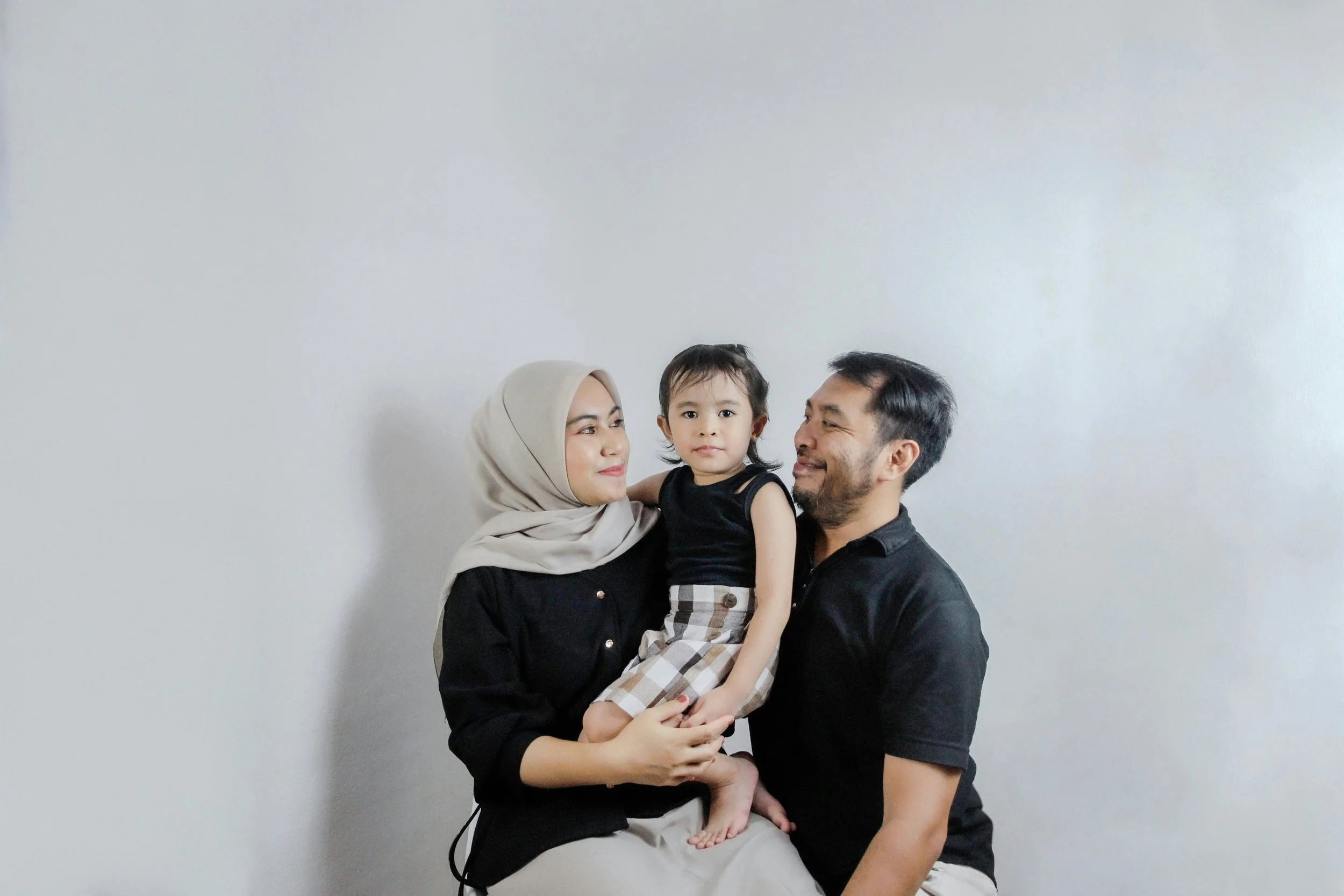
Can You Honour Your Parents and Still Heal?
Yes. This deserves to be stated plainly and without qualification.
Honouring your parents does not require you to pretend your childhood was fine. It does not require you to suppress your pain. It does not require you to expose yourself to continued harm. The Quran's command of kindness to parents is about your conduct towards them now. It is not a demand that you rewrite your history.
You can love your parents and acknowledge that they hurt you. You can make du'a for them and still seek therapy to process what they did. You can maintain a relationship with them, even a limited and boundaried one, while also doing the work of healing privately. These things are not contradictory.
What Islam asks of you is not silence. It is sincerity, mercy, and intention. You can bring all of those to a therapy room.
What Faith-Based Trauma Therapy Looks Like
Trauma therapy for Muslims who carry childhood wounds needs to hold two things at once: the clinical and the spiritual. Neither is sufficient alone.
Effective faith-based trauma therapy for Muslim adults might draw on:
EMDR (Eye Movement Desensitisation and Reprocessing). A clinically validated approach for processing traumatic memories that does not require extensive verbal disclosure. Particularly useful for clients who find it hard to talk about what happened.
Trauma-focused CBT. Helping clients identify and reframe the beliefs formed in childhood, beliefs like “I am not loveable,” “I have to earn my worth,” or “expressing emotion is weakness,” and replace them with narratives that are both psychologically healthier and Islamically grounded.
Somatic approaches. Working with the body's stored trauma responses, because childhood trauma in Muslim adults is not just a cognitive experience. It lives in the nervous system.
Spiritual integration. Helping clients rebuild or repair their relationship with Allah, often damaged by the conflation of an imperfect parent with a perfect Creator. Recognising that the harshness they experienced was human failure, not divine intention.
At Salam Space, our therapists understand that healing childhood wounds as a Muslim adult means navigating faith, family, and culture alongside the clinical work. You do not have to explain your context from scratch. We already understand the landscape.
READY TO FEEL UNDERSTOOD?
Faith-centered therapy, personalized for your journey.
Taking the First Step
Starting therapy for childhood trauma can feel like opening a door you have kept shut for a very long time. That is understandable. Here are a few things worth knowing before you do:
You do not have to have all the words. Many people who begin trauma therapy are not entirely sure what happened to them, only that something did and that it still affects them. That is enough to start.
You are not betraying your family by seeking help. Healing is not about assigning blame. It is about understanding your own story clearly enough to write a different chapter going forward.
You are allowed to want more for yourself. A life less shaped by fear, self-doubt, and old pain is not a luxury. It is something every Muslim adult is entitled to pursue.
Healing Is Not a Betrayal
Childhood trauma in Muslim adults is common, consequential, and deeply underaddressed. Too many Muslim men and women are living with the invisible weight of what happened to them in childhood, convinced that to name it would be disloyal, un-Islamic, or simply too painful to face.
But Islam has never asked anyone to carry pain indefinitely. The Prophet (peace be upon him) modelled a way of relating to children that was rooted in mercy and warmth. The Quran commands kindness to parents without commanding silence about harm. And healing, far from being a betrayal, is one of the most honest things a person can do.
You survived your childhood. Now, with the right support, you can actually heal from it.
Frequently Asked Questions
Is it haram to talk about what my parents did wrong?
No. Seeking help to process pain is not backbiting or disloyalty. It is an act of honesty and self-care that Islam encourages.
Does therapy mean I am blaming my parents?
Not at all. Therapy is about understanding your own patterns, not assigning blame. Many people finish trauma therapy with more compassion for their parents, not less.
Am I required to forgive my parents for what they did?
Islam strongly encourages forgiveness, but it is not the same as reconciliation, and it is not required to happen on a timeline or all at once. You can choose to forgive internally, as an act between you and Allah, without that meaning you owe your parents renewed access to your life. Forgiveness is also rarely a single decision. For most people, it is a choice they keep making, and a good therapist can help you get there without rushing you.
What if I cannot remember specific events, only feelings?
That is very common. Childhood trauma is often stored as feeling rather than memory. A skilled therapist can work with whatever you bring.
Can my faith help me heal?
Yes. Emerging research on faith-based interventions, including practices like dhikr, points to real gains in post-traumatic growth and resilience. Faith-based therapy integrates these alongside clinical tools rather than treating them as separate.
What if my parents are still in my life and still harmful?
A therapist can help you build a relationship with your parents that is boundaried and safe, without requiring you to cut them off or keep absorbing harm.
Is childhood trauma something I can fully recover from?
Yes. Recovery does not mean forgetting. It means the past no longer runs your present.
