
It is a Thursday afternoon in the MSA prayer room. You have a job portal open in one tab and, in another, a family group chat where an aunt has just asked whether you have "thought about rishta proposals now that you are finishing." You put the phone face down, finish your prayer, and roll up the mat a little more slowly than usual. Three years ago you would have said this room was ordinary. Now you are counting how many more Thursdays you have.
The final year of university is supposed to be a culmination. Everything you worked for is almost done. And yet for many Muslim students, the approach of graduation produces not relief but a specific and intensifying anxiety about what comes after. The structure of university, which has held the shape of life for three or four years, is about to disappear. In its place: a set of open questions about career, about marriage, about where to live, about who to be as an adult Muslim in a world that university has both prepared and not prepared you for.
At Salam Space, we work with students navigating this threshold, and with graduates who have already crossed it and are struggling to find their footing on the other side. This post is about both.
Why Graduation Can Be Particularly Anxiety-Producing for Muslim Students
Anxiety about life after university is not unique to Muslim students. But in our work with Muslim clients, we often see it arrive with extra layers, because several big questions land at the same time. We are describing what clients tell us here, not a measured comparison with other groups.
The multiple questions arrive simultaneously. For many Muslim students, graduation does not just raise the question of career. It raises career, marriage, family expectations, community standing, where to live, and how to keep a faith practice in an adult context that does not have the structure of university, all at once.
Family expectations often converge at graduation. The period after graduation is often when parents press most actively for marriage, for a return to the family home, for visible career success, for a life that fits the template they had in mind when they made the sacrifices they made. All of this can arrive just as the student is already navigating significant uncertainty.
The loss of the Muslim student community. For students who found genuine community in the MSA, graduation means losing the most organized Muslim peer group they have belonged to. Many graduates describe the post-university period as one of the loneliest stretches of their Muslim life, because the next equivalent community, if it exists at all, can take years to find.
The removal of the structure that held faith practice. University, for all its challenges, provides prayer spaces, MSA events, and a social context in which being Muslim has shared infrastructure. Professional adult life rarely provides an equivalent, so keeping up the practice and community that university made relatively easy takes far more independent effort.
The Questions Nobody Prepares You For
University prepares Muslim students for many things. It rarely prepares them for the specific questions that graduation raises.
“How do you be a Muslim adult in a professional world that was not designed with you in mind?”
“How do you find a spouse when the family network that would traditionally facilitate this is geographically spread and less engaged than it once was? “
“How do you keep up prayer when you are no longer in control of your own schedule?”
“How do you find a Muslim community in a new city when you are starting from scratch?”
These are not small questions, and the anxiety they produce is not irrational. They are real uncertainties about significant parts of life, arriving at the moment the external structure that has held everything together for years is disappearing.
BOOK A SESSION
Ready to take the first step?
Confidential, culturally sensitive therapy — available online.
The Grief of Leaving University
Alongside the anxiety, there is often something less acknowledged: grief. University, for many Muslim students, was the first place they had real peer community, intellectual freedom, and room to figure out who they were. Leaving it means leaving all of that, and the grief is real even when the departure is wanted.
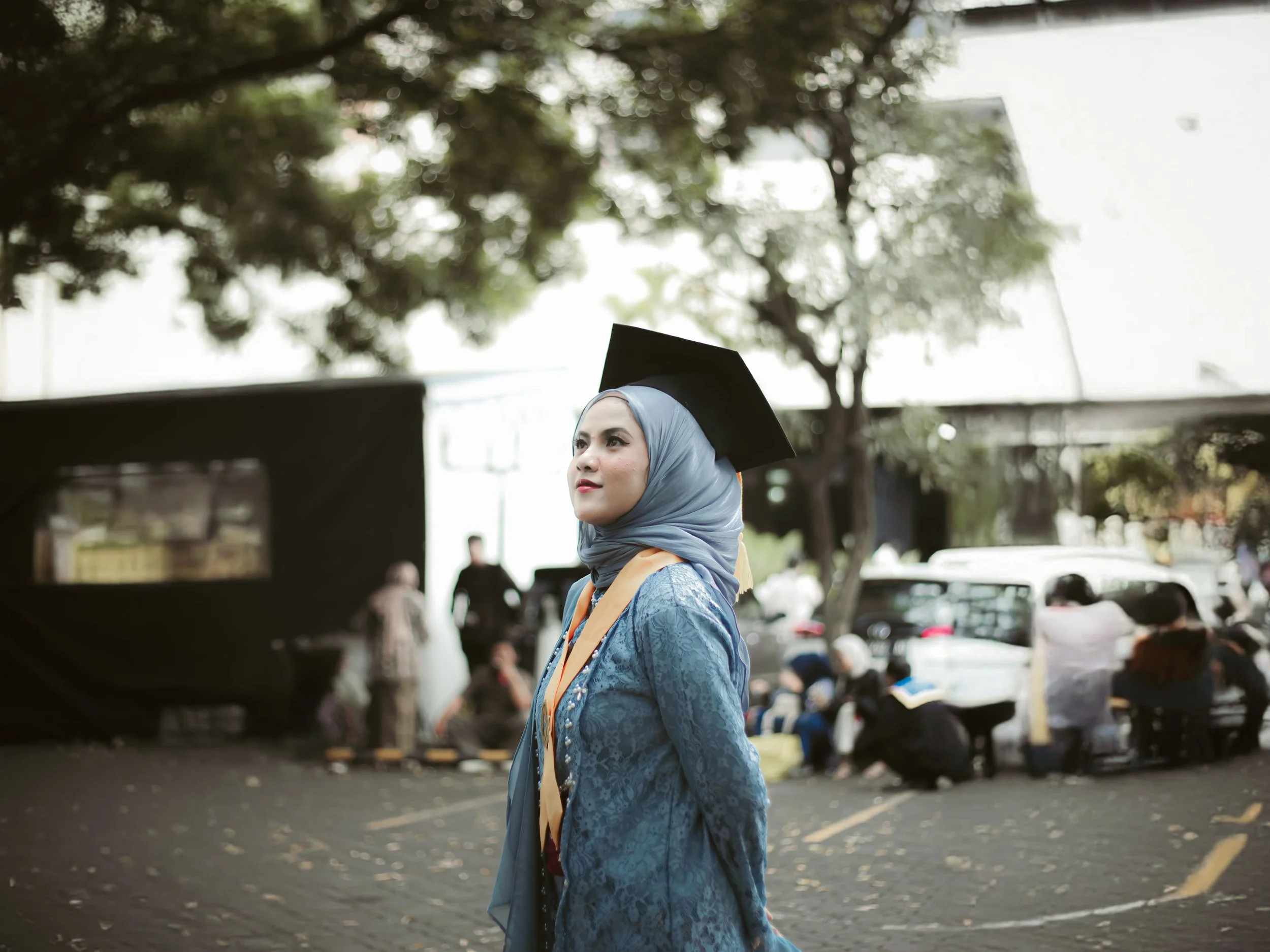
Many students suppress this grief because it does not fit the graduation story, which is supposed to be celebratory. They tell their families they are excited, they take the photographs, and they carry a quietly complicated emotional experience that nobody around them seems to have language for.
Naming this grief and giving it room is part of what makes forward movement possible. Students who skip past the ending without acknowledging what they are leaving behind often carry it with them, sometimes for years, in ways that make the next chapter harder to enter fully.
One small practice that helps some graduates is marking the ending on purpose: a last evening with the friends from the prayer room, a walk through the places that mattered, a message of thanks to the person who first made you feel at home on campus. Rituals of ending give grief somewhere to go, so it is not left to surface later as a vague heaviness you cannot explain.
What Islam Offers for Uncertainty
The Islamic tradition has deep resources for holding uncertainty with calm. One of them is tawakkul, taking the means available to you and then trusting Allah with the outcome. The clearest picture of it comes from a short exchange. A man asked the Prophet, peace be upon him, whether he should tie his camel and trust in Allah, or leave it untied and trust in Allah. The Prophet answered, tie it, and trust in Allah (Jami` at-Tirmidhi 2517, a hasan narration). That is directly applicable to the uncertainty of life after university: send the applications, make the calls, ask for advice, and then let go of the part that is not in your hands.
The Quran speaks to this too. In the passage of Surah Al-Baqarah that includes verse 216, which is originally addressed to the believers about fighting, comes a line often taken as a wider reminder: "Perhaps you dislike something which is good for you and like something which is bad for you. Allah knows and you do not know" (2:216, Clear Quran translation). The verse is not a dismissal of anxiety. It is an orientation: the future is uncertain, and in Islam that uncertainty is held by a Creator who sees what we cannot.
The same balance appears in Surah Al 'Imran (3:159), which tells the Prophet to consult people, and then, once a decision is made, to rely on Allah. Consult, decide, then trust. This is not passivity. It is a particular kind of courage: acting in the face of uncertainty instead of being paralyzed by it.
Practical Navigation of the Post-University Transition
Separate what is urgent from what is simply anxious. Not everything that feels urgent in the months after graduation actually is. Career can be explored over months. Marriage can be approached gradually. Some things that feel as if they need resolving immediately are things that have time. Telling the two apart often reduces the overwhelm.
Build Muslim community in your new context before you need it desperately. Find a mosque, attend Friday prayers, look for MSA alumni networks or young professional Muslim groups in your city. Doing this in the first weeks of a new chapter, rather than after isolation has set in, tends to go better.
Keep at least some of the practices that sustained you at university. The specific practices that campus made easy may need to be rebuilt in a new form. What matters is the underlying habit, not the exact format it took during university.
Give yourself time to adjust. Many people find the post-university transition takes longer than they expected. Feeling unsettled for a good while after graduating is common and not a sign that something is wrong with you.
Talk to someone who has crossed it. A slightly older MSA alum, a cousin a few years ahead, or a mentor from your mosque can often tell you what the first year was really like, which is more reassuring than any checklist.
Also read: Muslim Identity and Faith at a Secular University
How Therapy Helps
Processing the grief of leaving university. Having a place to acknowledge, without judgment, what was valuable about the university chapter and what is being left behind allows for more genuine forward movement.
Holding uncertainty without being consumed by it. Therapy can help you build the capacity to tolerate significant uncertainty and take the next practical step without needing the whole future resolved, which is often the most useful shift available in this period.
Navigating the convergence of family expectations. Many families press hardest on marriage and career right after graduation. Therapy can help you gain clarity about your own direction and find language for communicating it to family.
Building identity outside the student role. For students who built their identity around being a student, graduation raises a real question: who am I if not a student? Therapy can help you build an adult identity that does not depend on any single role.
Connecting Islamic concepts of trust to your actual situation. A faith-informed therapist can help ground the anxiety of this transition in the Islamic ideas of tawakkul and sabr, in a way that does not dismiss the difficulty but offers real resources for holding it.
READY TO FEEL UNDERSTOOD?
Faith-centered therapy, personalized for your journey.
Graduation Is a Threshold
The anxiety of life after university for Muslim students is real, layered, and underserved by the generic career advice and graduation support that universities tend to offer. The questions being faced are not just professional. They are existential, relational, and faith-related, and they deserve support that understands all of those dimensions.
Graduation is a threshold, not a destination. On the other side of it, with the right support, is the adult Muslim life that all the preparation was for. Salam Space is here for the transition, in whatever stage of it you find yourself.
Frequently Asked Questions
Is it normal to feel more anxious as graduation approaches rather than less?
Yes. The approach of a major life transition, with all its uncertainty and open questions, often intensifies anxiety in the period just before it. This is common and does not mean anything is wrong with you or your readiness.
I feel like I am losing the only Muslim community I have ever had. How do I cope with that?
This grief is real and deserves to be named as such. Building new community after university is possible but takes time, and it is worth starting early rather than waiting until isolation is already significant. Looking for MSA alumni groups and a mosque near where you will live are good first steps.
My family expects marriage and a prestigious career at the same time. How do I manage those pressures?
Pressure from family around several major decisions at once is one of the most common post-graduation themes we hear from Muslim young adults. There is no single answer, but clarity about your own direction, and language for communicating it respectfully, often helps. It can also help to separate the two conversations so that you are not answering both in one sitting.
How do I maintain my faith practice in professional life when I am no longer on a university campus?
It takes deliberate planning rather than assuming it will happen on its own. Finding prayer spaces near your workplace, locating a mosque community in your new location, and reconnecting with Muslim peers in a professional setting are all worth prioritizing early.
Is post-graduation anxiety a reason to see a therapist?
Yes. Significant anxiety about a major life transition is a legitimate reason to seek support, and you do not need to be in crisis. Many people find that talking it through with a trained professional helps them make decisions more clearly.
Can Salam Space work with recent graduates as well as current students?
Yes. Salam Space works with Muslim clients at all life stages, including the post-university transition. Sessions are available virtually across Texas, or in person in Austin and Houston.
Should I move back in with my parents after graduating?
There is no single right answer, and it is a real decision, not a failure either way. Living at home can reduce costs and keep you close to family, but it can also bring back old dynamics at the exact moment you are trying to form an adult identity. It can help to agree on expectations before you move back, such as how rent, household help, and privacy will work, and to set an end date or a review point so that it feels like a chosen stage rather than a default. If the decision is tangled up in guilt or family pressure, that is a good thing to bring to therapy.
How do I handle prayer, Ramadan, or Eid at a first job?
Many workplaces are willing to accommodate prayer breaks, flexible hours, or time off for Eid when asked early and clearly. It often helps to raise it after you have an offer, rather than during interviews, and to propose a specific arrangement, such as a short break at set times, instead of an open-ended request. If you are not sure what your rights are in your state, check with your employer's HR department or a local civil rights organization. If worry about this is making you reluctant to apply for jobs you want, that worry itself is something a faith-informed therapist can help you work through.
