
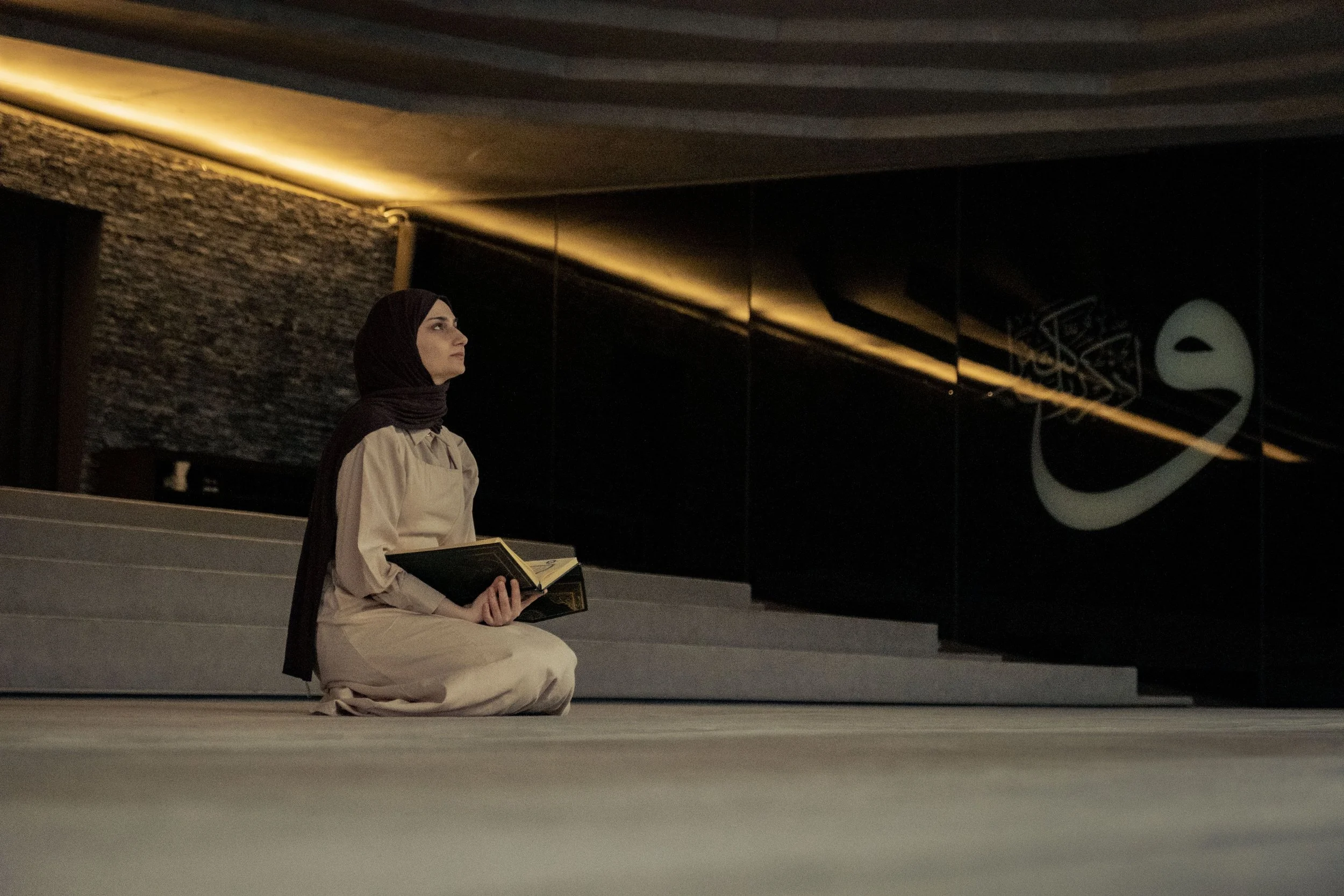
She prays on time, every time. She has not missed a fast since she was twelve. And still, most nights, she lies awake running through the day, certain that one small thing she did was the one Allah will not forgive.
From the outside, this looks like devotion. Someone who prays often, who avoids sin carefully, who thinks regularly about the Day of Judgement. But for some people, this fear has stopped being the kind of reverent awareness Islam describes and has become something closer to constant dread, a feeling that no amount of worship is ever quite enough, and that punishment is always just around the corner.
At Salam Space, we talk to Muslims caught in exactly this place. This post is about understanding the difference, and finding a way back to a faith that brings peace rather than terror.
Remembering Death Is Healthy. Here Is Where It Can Go Wrong.
Islam genuinely encourages the remembrance of death, dhikr al-mawt. The Prophet Muhammad, peace be upon him, said to remember often “the destroyer of pleasures,” meaning death, a hadith graded hasan. This is not meant as a source of despair, but as a tool that sharpens priorities and reduces attachment to things that do not ultimately matter.
For most people, this remembrance functions exactly as intended. It is sobering, occasionally uncomfortable, and ultimately motivating. For some people, though, this remembrance does not recede. It becomes a near-constant background hum, sometimes intensifying into something closer to dread or panic. Thoughts about death intrude repeatedly and bring with them a wave of anxiety that does not feel proportionate to a passing reminder. This is where healthy remembrance can tip into something that needs a different kind of attention.
Taqwa or Religious Anxiety? The Line That Matters
Taqwa, often translated as God-consciousness or piety, is one of the central concepts in Islam. The Al-Furqaan Foundation notes that when fear of divine punishment becomes overwhelming and obsessive, persisting despite sincere repentance and genuine reform, it may no longer represent healthy taqwa but rather scrupulosity, a religiously framed anxiety disorder.
The Quran itself describes the emotional posture of true believers with remarkable balance: “They abandon their beds, invoking their Lord with hope and fear.” (Surah As-Sajdah, 32:16). Hope, raja, and fear, khawf, are described together, as a pair, intentionally. Islamic scholarship has long taught that fear without hope leads to despair, and hope without fear leads to complacency, and scholars have long illustrated this balance with an image worth sitting with: fear and hope as two wings of a bird, neither able to fly without the other. The healthy spiritual state is one that holds both.
Religious anxiety is what happens when that pair becomes unbalanced, when fear dominates so completely that hope becomes almost inaccessible. A person caught in this state may know, intellectually, that Allah is described as Ar-Rahman and Ar-Raheem, the Most Merciful, repeatedly throughout the Quran. But emotionally, that mercy feels distant or unavailable to them specifically.
What This Actually Looks Like
Fear of Allah's punishment and anxiety, when it crosses into religious anxiety or scrupulosity, can present in a range of ways. A 2025 study in the Journal of the British Islamic Medical Association describes this as pathological guilt, doubt, and distress arising from intrusive thoughts about violating religious or moral beliefs. In practice this might look like:
Persistent doubt about repentance. Repeatedly seeking forgiveness for the same sin, sometimes years after it occurred, because of a recurring fear that the previous repentance was not sincere enough or was not accepted.
Catastrophic interpretation of ordinary events. Interpreting illness, bad news, or even minor misfortunes as direct, personal punishment from Allah for specific past actions, a flat tire becomes ‘this is Allah punishing me for missing dhuhr last week,’ rather than just a flat tire.
Intrusive thoughts about death and the afterlife. Sudden, unwanted, vivid thoughts about dying, the process of death, or punishment in the grave or hereafter, that arrive without warning and are difficult to dismiss.
Compulsive religious checking. Repeating prayers, recitations, or specific phrases an exact number of times, driven by fear of consequences if done incorrectly, even when this repetition causes significant distress.
Avoidance of religious content. In some cases, the anxiety becomes so overwhelming that a person begins avoiding the very things that would normally nurture their faith, because these have become associated with dread rather than comfort.
If thoughts about death, judgement, or Allah's punishment have become a source of constant distress rather than occasional reflection, you do not have to carry this alone. Salam Space offers a space to talk this through.
BOOK A SESSION
Ready to take the first step?
Confidential, culturally sensitive therapy — available online.
Why This Is So Hard to Talk About
One of the cruellest features of religious anxiety is that it often feels impossible to discuss without it sounding like a complaint about faith itself, or worse, like evidence of weak faith.
Someone experiencing intense fear of Allah's punishment may worry that mentioning this to an imam, a parent, or a friend will be met with responses that intensify the very fear they are struggling with: more emphasis on the seriousness of sin, more reminders of accountability. For someone whose fear is already disproportionate, this kind of response can deepen the anxiety rather than ease it.
There is also a quieter fear underneath this: that questioning the intensity of this fear is itself a spiritual failure, that a ‘good’ Muslim should feel exactly this afraid, and that wanting relief from it represents wanting to be less devoted. This framing keeps people stuck, because it frames the anxiety itself as a sign of righteousness rather than as something that has become disconnected from the balanced faith Islam actually describes.
It does not have to be said to family first. Naming it plainly to a therapist, even in one sentence, is often the easier starting point: ‘I think my fear of Allah's punishment has stopped working the way it's supposed to. It's not pulling me toward anything anymore, it's just dread, all the time.’ That single sentence is often enough to begin with.
When This Often Shows Up Hardest
Religious anxiety rarely stays at a constant level. It tends to spike around specific moments, and recognising the pattern can make it feel less random and overwhelming.
A death in the family or community. A funeral or janazah can bring the fear of the grave and the afterlife into sharp, sudden focus, especially when it follows someone close.
Ramadan and other high-worship periods. Months centered on increased worship, reflection, and accountability can intensify existing scrupulosity rather than ease it, even though they are meant to bring peace.
A khutbah or lecture focused heavily on punishment. Sermons that lean hard on fear and consequence, without the balancing emphasis on mercy, can land very differently for someone already struggling with this, sometimes undoing weeks of progress in a single sitting.
A personal illness or health scare. Facing mortality directly, even briefly, can turn an abstract, background fear into something immediate and consuming.
None of these moments are the problem. They are simply the occasions where an existing imbalance tends to surface most visibly, which is itself useful information for treatment.
What Genuine Islamic Teaching Offers Here
A hadith narrated in Riyad as-Salihin, agreed upon by Bukhari and Muslim, describes Allah's mercy as prevailing over His wrath, recorded by Allah Himself in a book kept with Him above His Throne. The Quran describes Allah as accepting repentance from His servants and forgiving sins, repeatedly, using language of generosity rather than reluctance.
None of this is meant to dismiss accountability, which is also real and part of the Islamic framework. But the proportion matters. The Quran and Sunnah describe a relationship with Allah that includes accountability within a much larger context of mercy and the genuine possibility of being forgiven. When fear of punishment becomes so large that this mercy feels theoretical rather than real, something has gone out of balance, and that imbalance is not a sign of superior faith.
A Dua for When the Fear Feels Too Heavy
It is reported that the Prophet Muhammad, peace be upon him, rarely left a gathering without making this supplication for his companions, narrated by Ibn 'Umar and graded hasan gharib: “O Allah, apportion for us from Your fear that which will come between us and acts of disobedience to You, and from obedience to You that which will lead us to Your Paradise, and from certainty that which will make the trials of this world easy for us.”
Notice what is actually being asked for here: not more fear, but the right amount, just enough to be a barrier against disobedience, not a barrier against peace itself. Worth returning to on the nights when fear has stopped feeling like a barrier and started feeling like the whole room.
How Therapy Helps with Religious Anxiety
Therapy for fear of Allah's punishment and anxiety, when it has become disproportionate, does not involve dismissing faith or arguing someone out of their beliefs. It involves a careful, respectful approach to a genuine psychological pattern that happens to be expressed through religious content.
Distinguishing the thought from the self. Helping clients understand that intrusive thoughts about death, punishment, or blasphemy are a feature of how anxiety operates, not a reflection of their character, sincerity, or relationship with Allah. In practice, this can be as simple as a therapist helping a client notice and say, ‘That is an anxious thought passing through, not a message from Allah,’ rather than treating every intrusive thought as something that must be resolved or atoned for on the spot.
Exposure and response prevention, adapted thoughtfully. For the compulsive checking and repetition that often accompanies this kind of anxiety, gradual, supported reduction of these compulsions, through ongoing talk therapy, can be genuinely effective, when done with care for the religious significance of the practices involved.
Reconnecting with the full picture of Islamic teaching. Working through, slowly and without pressure, the parts of the Quran and Sunnah that emphasise mercy, patience, and hope, not as a one-time argument, but as something that can gradually become emotionally accessible again.
Addressing the underlying anxiety. In many cases, religious anxiety co-occurs with, or is an expression of, a broader anxiety disorder. Treating that underlying anxiety alongside the religious content it has attached itself to is often a significant part of finding relief.
A non-judgmental space. A space where this can be discussed honestly, without the fear that doing so will be received as a lack of devotion, is itself part of what helps.
Sessions are available virtually anywhere in Texas, or in person in Austin or Houston, whichever feels more comfortable to start with. And if cost or insurance coverage is part of what has been holding you back, Salam Space works with most major insurance plans and is upfront about pricing before you ever book, so the team can help you check your coverage before your first session.
PRICING & INSURANCE
Wondering what therapy will cost?
Most insured members pay around $20–$25 per session.
Not a Sign of Weak Faith. A Sign Something Is Out of Balance.
Fear of Allah's punishment and anxiety exist on a spectrum, and somewhere on that spectrum, healthy taqwa gives way to something that causes genuine suffering rather than genuine growth. If thoughts about death, judgement, or punishment have stopped functioning as reminders and started functioning as a near-constant source of dread, that is worth taking seriously.
The Quran describes believers who hold hope and fear together. If fear alone has taken over, that is not a sign that your faith is too strong. It is a sign that something has come out of balance, and balance can be restored.
Salam Space is here to help you find your way back to that balance.
Frequently Asked Questions
Is it wrong to feel scared when I think about death and judgement?
No. A degree of reflection on death and accountability is a healthy and encouraged part of Islamic life. The concern is when this fear becomes constant, overwhelming, or disconnected from hope, rather than functioning as an occasional, motivating reminder.
How do I know if my fear of Allah is healthy taqwa or religious anxiety?
If the fear motivates positive action and coexists with a genuine sense of hope and mercy, it is likely functioning as healthy taqwa. If it is constant, disproportionate, accompanied by compulsive behaviours, or leaves little room for hope despite sincere effort, it may have become religious anxiety worth addressing.
Is this the same thing as ‘waswas’?
It is related, but more specific. The everyday whispers many Muslims experience during wudu or prayer, waswasa, are a normal part of the human experience and are generally best handled by simply dismissing them. Scholars and researchers describe a more overwhelming, clinical form of this as waswas al-qahri, intrusive thoughts severe enough to meet the clinical threshold for OCD, which is closer to what this post is describing. If the thoughts are occasional and easy to brush off, that is ordinary waswasa. If they are constant, distressing, and accompanied by compulsions, it is worth treating as the more serious condition it is.
Will a therapist try to change my religious beliefs?
A faith-informed therapist at Salam Space works within your beliefs, not against them. The goal is to address anxiety that has attached itself to religious content, not to challenge the validity of your faith.
I keep having intrusive thoughts about blasphemy or death during prayer. Does this mean something is wrong with my iman?
No. Intrusive thoughts of this kind are a recognised feature of anxiety and OCD, and Islamic scholarship has long held that thoughts which arrive uninvited and are not acted upon do not reflect a person's faith or character.
Can this kind of anxiety be treated without medication?
Many people find significant relief through therapy alone. For some, medication alongside therapy is helpful, and this is a decision to make with a qualified professional based on your specific situation.
What if my family or community sees seeking help for this as a lack of faith?
Seeking help for an anxiety condition, even one expressed through religious content, is not a rejection of faith. Many scholars and Muslim mental health professionals increasingly recognise religious anxiety as a genuine condition deserving of compassionate, informed care.
Why does this seem to get worse during Ramadan or right after a death in the family?
Periods of increased worship and moments that confront mortality directly tend to intensify any existing religious anxiety, even though they are meant to bring a person closer to peace. This is a common pattern, not a sign that something is especially wrong with your faith during those times, and it is worth mentioning to a therapist if you notice it.
