
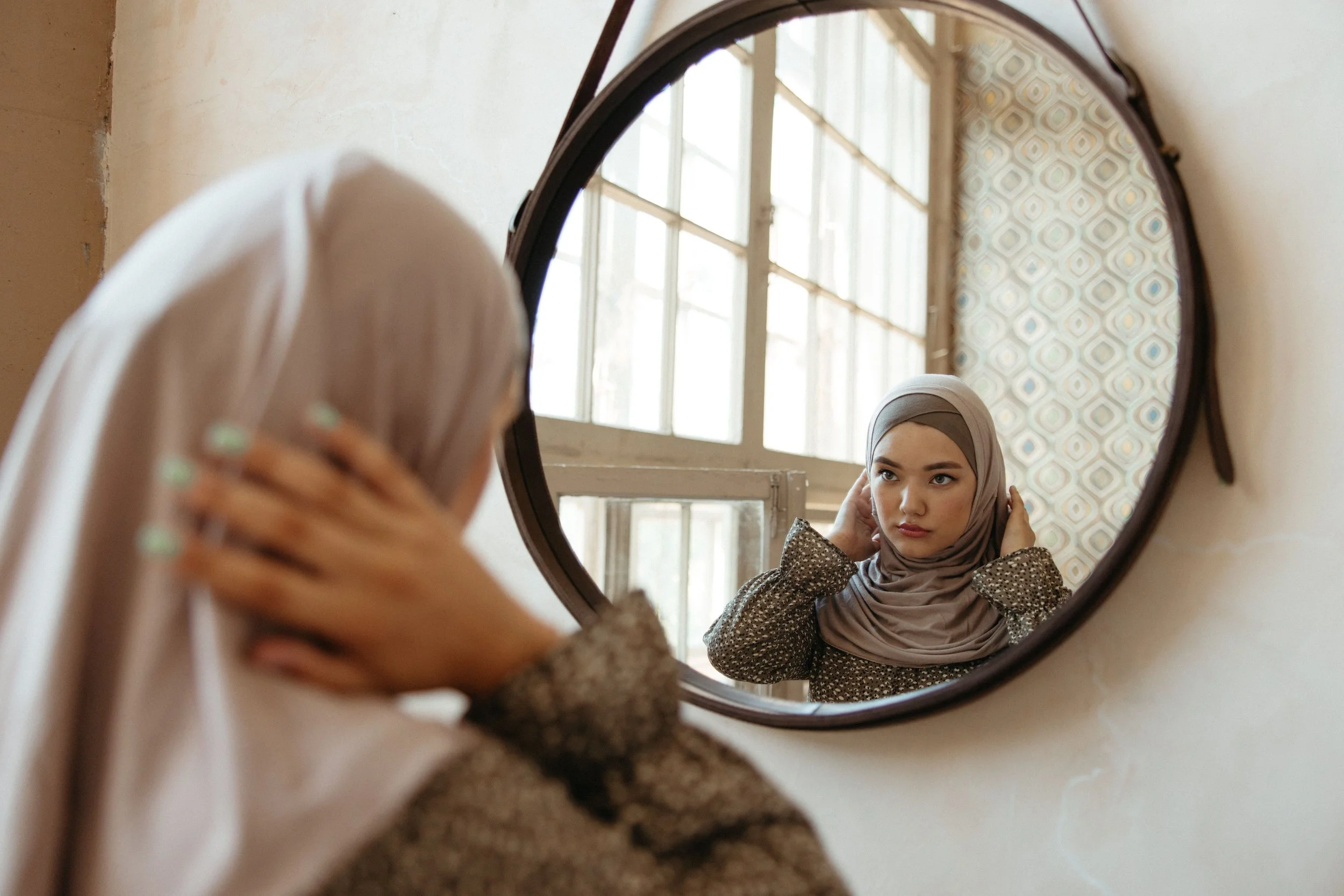
Disordered eating in Muslim women rarely looks the way people expect. It often hides behind modesty, behind fasting, behind the quiet assumption in many communities that this is a 'Western problem' that does not really touch Muslim families. But the relationship between food, body, faith, and worth is often far more complicated than that assumption allows.
At Salam Space, we hear from women who have been carrying this quietly for years, often without ever using the words disordered eating to describe what they are experiencing. This post is about naming that experience honestly.
The Myth That This Does Not Happen to Us
One of the most persistent barriers to Muslim women getting support for disordered eating is the belief, inside and outside the community, that it simply does not happen to 'us,'. Eating disorders are often culturally coded as a white, Western, affluent phenomenon. A 2025 systematic review pooling 11 studies comparing Muslim and non-Muslim women found that Muslim women overall reported somewhat lower rates of body dissatisfaction and disordered eating than non-Muslim women, particularly those who wear hijab, though individual studies varied considerably, a finding that still directly challenges the assumption that this is simply not a Muslim issue, the reality is more nuanced than either 'it happens equally' or 'it doesn't happen at all.'
This myth does real harm. When a Muslim woman is struggling with her relationship to food and her body, and the people around her have never considered that this could be something Muslim women experience, she is far less likely to be noticed, far less likely to be asked how she is doing, and far less likely to have the language to describe what is happening to her in the first place.
BOOK A SESSION
Ready to take the first step?
Confidential, culturally sensitive therapy — available online.
Where the Pressure Actually Comes From
The research on body image in Muslim women is genuinely complex, and it is worth sitting with that complexity rather than reaching for a simple story.
Some studies have found that wearing hijab is associated with lower body dissatisfaction and less pressure to conform to certain appearance ideals, suggesting that modesty practices can, for some women, offer a genuine sense of protection from the kind of constant external evaluation that drives body image struggles in many other contexts.
But that same research found that hijab-wearing women report significantly higher perceived discrimination, and other studies have found that unveiled Muslim women report more body checking behaviours and higher disordered eating scores than veiled Muslim women. The picture is not simply 'hijab protects' or 'hijab does not matter.' It is that the relationship between modesty, identity, faith, and body image is genuinely individual, and shaped heavily by family and community context.
What does seem to come up consistently, across studies and in the lived experience of many Muslim women, are a few specific sources of pressure that exist regardless of hijab status:
Comments about weight as a form of greeting. In many Muslim cultures, commenting on someone's body, whether they have gained or lost weight, is treated as a normal, even affectionate, part of greeting someone, particularly at family gatherings. For someone with a complicated relationship to food and body, these comments can be genuinely distressing, even when they are not intended unkindly. Something as simple as 'I'd rather we talk about something other than my body today,' said warmly but clearly, can hold a boundary without turning the moment into a confrontation.
Marriage-related body scrutiny. In communities where marriage involves families assessing potential matches, a woman's body can become a subject of evaluation in ways that feel deeply uncomfortable, regardless of how that evaluation is framed.
The collision of cultures. For Muslim women living as a minority, particularly second-generation women, navigating two sets of appearance expectations, one from their family's cultural context and one from the broader society, can create a genuinely difficult internal conflict about how their body 'should' look and to whom that even matters, a tension that shows up in Muslim teen identity more broadly, not just around body image.
Food as love, and food as conflict. In many Muslim households, food is one of the primary ways care is expressed. This can create real tension for someone who is struggling with their relationship to food, where declining food can be experienced by family as a rejection of love itself.
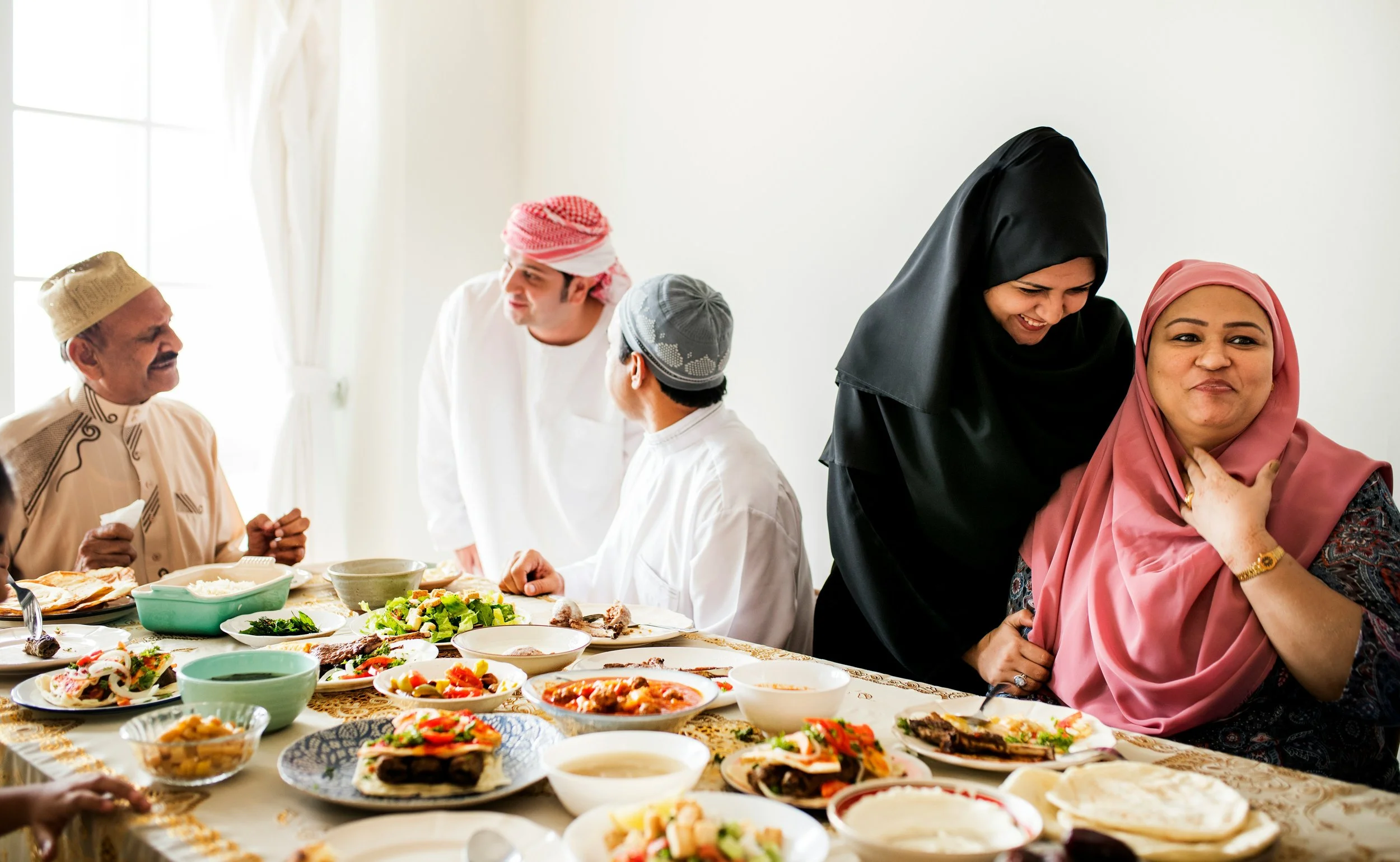
Ramadan: A Time of Meaning, and Sometimes a Time of Risk
For Muslim women who already have a difficult relationship with food, Ramadan can bring up complicated feelings. Qualitative research with young Muslim women has identified themes of family and community expectations to fast, the exertion of control over eating behaviours, and preoccupation with weight and appearance during this period, alongside the genuine spiritual significance the month holds.
It is worth being honest about this rather than glossing over it. For some women, fasting during Ramadan is experienced exactly as intended: a spiritually meaningful practice, embedded in community, that has nothing to do with body image. For others, particularly those with a current or past difficult relationship with food, the structure of fasting can interact with that difficulty in ways that feel confusing and distressing, sometimes bringing up urges or thought patterns that had felt more settled.
Islam itself makes space for this. The Quran is explicit that fasting is not obligatory for those who are unwell (Surah Al-Baqarah, 2:184–185), and that illness includes conditions that genuinely affect a person's ability to fast safely. If fasting feels like it is putting your health, mental or physical, at real risk, that is precisely the kind of situation Islamic scholarship has long made room for. This is not a question to navigate alone or in silence. It is something worth discussing honestly with both a knowledgeable, compassionate scholar and a healthcare provider who understands your full picture, so that any decision about fasting is made with genuine care for your wellbeing, not despite it.
If You're Advised Not to Fast, What Then?
For a woman already managing a difficult relationship with food, being advised not to fast this Ramadan can feel like a loss, not just of a religious obligation, but of a central way she connects to her community and to Allah during the month that matters most.
It helps to know that fasting is one expression of Ramadan, not the entirety of it. Islamic tradition recognises many other ways to engage meaningfully with the month: reciting and reflecting on the Quran, increasing dhikr, giving charity, helping prepare or deliver iftar for others even if you are not fasting yourself, attending taraweeh prayers, and simply being present with family and community in the ways the month brings people together. None of these are consolation prizes. They are genuine, full expressions of what the month is actually for.
This is also not a decision to make alone, or purely clinically. Islamic scholarship has long made room for illness, including conditions that affect a person's relationship with food, as valid grounds not to fast, in the same way it does for pregnancy, chronic illness, or travel. Speaking with a knowledgeable, compassionate scholar alongside a treatment provider means the decision is made with both your deen and your health genuinely considered together, not treated as being in conflict. And whatever you decide this year does not have to be the final word on every Ramadan going forward, recovery can change what is possible from one year to the next.
What Islam Actually Says About the Body
Islam's teachings about the body are, at their core, about balance, gratitude, and care, not about appearance or control.
The Prophet Muhammad, peace be upon him, told a companion who was fasting every day and praying all night that his body had a right over him (Sahih al-Bukhari 1975), and that neglecting that right was not piety. The Quran repeatedly speaks against excess in all directions, both overindulgence and the kind of severe restriction that some early ascetic movements practised and that the Prophet himself discouraged among his companions.
The body, in Islamic understanding, is an amanah, a trust from Allah. A relationship with food and one's body that involves significant distress, rigid control, or harm is not a sign of discipline or piety. It is a sign that something needs care and attention, in exactly the same way that any other illness affecting the body would.
If you have ever felt that your relationship with food has become wrapped up in ideas about being a 'good' or 'disciplined' Muslim, it may help to know that this framing does not reflect how Islam actually understands self-care. Caring for your relationship with food and your body, including seeking support when that relationship has become difficult, is consistent with, not in tension with, looking after the trust Allah has placed in you.
READY TO FEEL UNDERSTOOD?
Faith-centered therapy, personalized for your journey.
Why This Goes Unnoticed in Muslim Communities
Several things combine to keep disordered eating in Muslim women hidden, even from the people closest to them, much the same way silence protects a lot of mental health struggles in Muslim communities more broadly.
Families may genuinely not have the framework to recognise what they are seeing. A daughter who eats very little might be seen as simply being a 'light eater' or as having a small appetite, framings that exist in many cultures and that can mask something more serious. A family that is reassured by a daughter eating normally in front of them may have no idea what happens afterward, or what her internal experience of that meal actually was.
There is also, in some communities, a quiet relief attached to weight loss that makes it harder for anyone to raise concerns. Comments framed as compliments, about someone looking 'better' or having 'finally' lost weight, can inadvertently reinforce exactly the behaviours that are causing harm, while making it socially very difficult for that person to talk about what is actually going on underneath.
And for the woman herself, the absence of any cultural script for 'a Muslim woman with an eating disorder' can mean she does not recognise her own experience for what it is, sometimes for years.
How Faith-Informed Therapy Helps
Disordered eating is a serious area that benefits enormously from specialist support, and faith-informed talk therapy at Salam Space, available virtually anywhere in Texas or in person in Austin and Houston, works best as part of a broader picture of care that may also include medical and nutritional professionals who specialise in eating disorders specifically.
Within that picture, a faith-informed therapist can offer something distinct:
A space where faith is not treated as part of the problem. Some women worry that talking about their relationship with food will lead a therapist to view their religious practices, including modesty or fasting, with suspicion. A faith-informed therapist understands the difference between religious practice and disordered behaviour, and does not pathologise the former.
Help navigating family dynamics around food. Many Muslim women need support specifically around managing family gatherings, comments about weight, and the cultural weight that food carries in their households, alongside the deeper therapeutic work.
Reconnecting with the body as an amanah. Reframing the relationship with the body through Islamic concepts of trust, gratitude, and balance, rather than through the lens of control or appearance, can be a genuinely meaningful part of recovery for many Muslim women.
Coordinated support. Where appropriate, a faith-informed therapist can work alongside, and help connect clients to, specialist eating disorder services, ensuring that the clinical and spiritual dimensions of care are not working in isolation from each other.
Not a Lack of Discipline. A Need for Care.
Disordered eating in Muslim women is real, even when it is rarely named. It hides behind assumptions about culture, behind modesty, behind the genuine and meaningful practice of fasting, and behind a community-wide reluctance to imagine that this could be something happening to someone we know.
If any part of this has resonated with you, please know that this is not a reflection of your faith, your discipline, or your worth. It is something that deserves care, the same way any other difficulty with your health would.
Salam Space is here to talk, without judgment, about whatever you are carrying.
Frequently Asked Questions
Does wearing hijab mean I am protected from body image struggles?
Not necessarily. Research on this is genuinely mixed. For some women, modesty practices offer real protection from certain pressures. For others, body image struggles exist regardless of hijab status, often shaped more by family dynamics and broader cultural pressures than by clothing choices.
Is it wrong to feel anxious about fasting if I have struggled with food before?
No. This is a real and recognised experience for some people, and it does not reflect a lack of faith. Islam itself makes allowances for illness, and a difficult relationship with food is something worth discussing openly with a knowledgeable scholar and a healthcare provider together, so any decisions are made with your wellbeing genuinely in mind.
I was told not to fast this Ramadan for my recovery. How do I still feel connected to the month?
Fasting is one expression of Ramadan, not the only one. Increasing dhikr and Quran recitation, giving charity, helping with iftar for others, and attending taraweeh are all genuine, full ways to engage with the month. Talking the decision through with both a knowledgeable scholar and a healthcare provider can also help it feel like a considered choice rather than something done in isolation.
My family comments on my weight a lot, but I do not think they mean harm. Can this still affect me?
Yes. Comments do not need to be intended unkindly to have a real impact, especially when they happen repeatedly over many years. Your response to these comments is valid, regardless of the intention behind them.
I have never used the words 'eating disorder' to describe what I experience. Does that mean it is not one?
Not necessarily. Many people who experience disordered eating do not initially recognise it, particularly when there is no cultural script that includes someone like them. If your relationship with food causes you distress, that is worth exploring with support, regardless of what label, if any, fits.
Where can I find support specifically for eating disorders?
Alongside faith-informed therapy, organisations that specialise in eating disorders can offer additional support. In the United States, the National Alliance for Eating Disorders helpline is a good starting point for finding specialist care. Salam Space can also help you think through what combination of support might be right for you.
Can therapy help even if I am not sure I am ready to change anything yet?
Yes. You do not need to be ready to change anything in order to start talking about it. Many people begin therapy simply by talking honestly about what they are experiencing, without any pressure to have a plan.
