
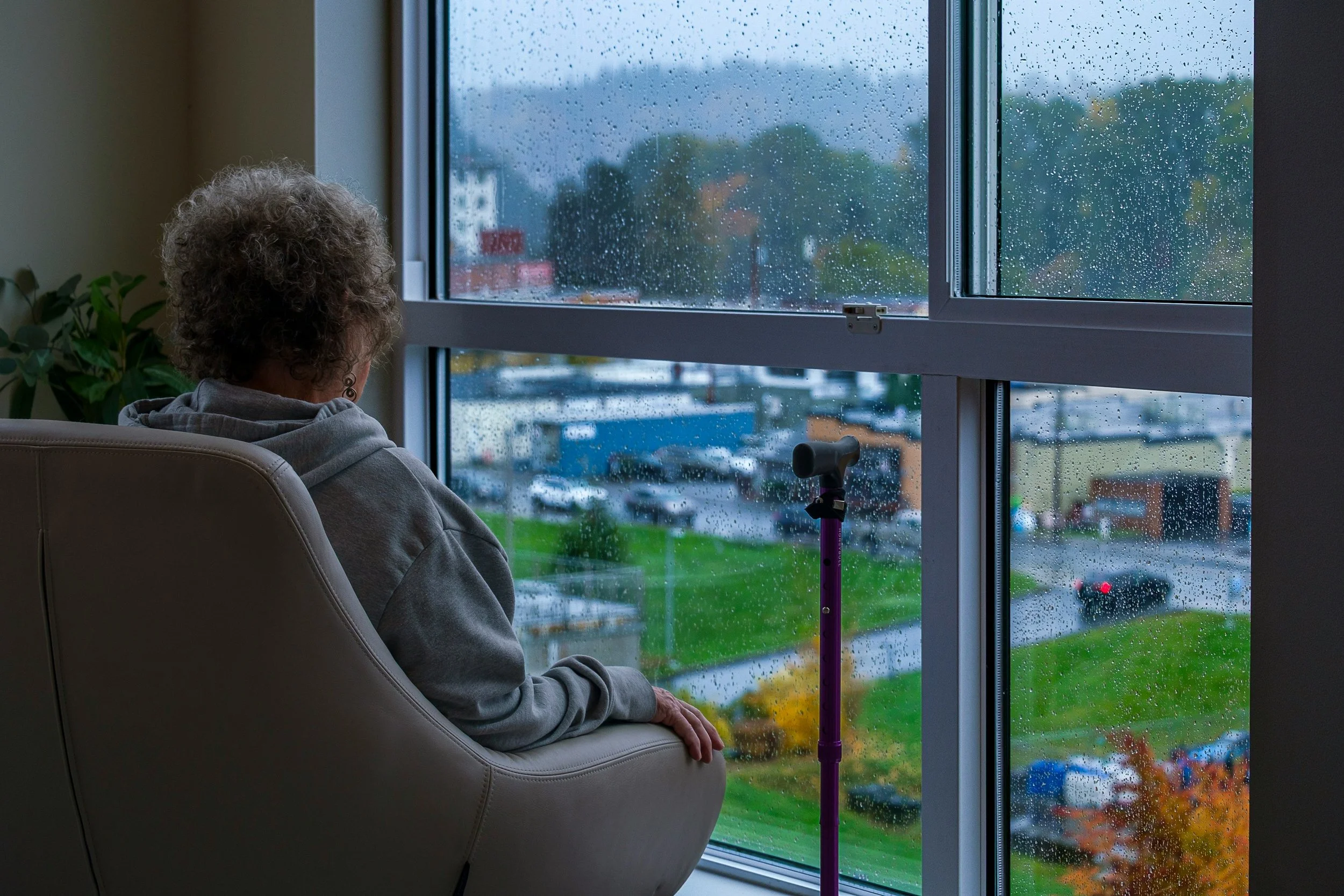
They spent decades adjusting to a new country, a new language, and a new life so that their children could have more opportunities. Now those children are grown, working long hours, raising their own families, and the parents who made it all possible are spending most of their days at home, often alone.
Loneliness among elderly Muslim immigrants is one of the quietest mental health crises in the community, precisely because it does not look like a crisis from the outside.
At Salam Space, we hear from adult children worried about their aging parents, and from elders themselves who are struggling with an isolation nobody quite recognised was happening. This post is about naming that loneliness and what can genuinely help.
A Loneliness That Looks Different from the Outside
A 2020 study of Muslim immigrant older adults in Alberta, Canada, “Growing Old is not for the Weak of Heart”, spent a year interviewing 67 older adults and community stakeholders, across 23 individual interviews and 7 focus groups, about what growing old in a new country actually felt like. Its central finding was what the researchers called an exclusion lens: overlapping ageism, racism, and, for many women, sexism, that can quietly shut older immigrants out of both mainstream and community life, even as they actively find their own ways to stay connected.
From the outside, an elderly Muslim immigrant parent might appear to be doing fine. They have a home. Their children visit, at least sometimes. They are not, technically, alone in the world. But day to day, the texture of their life can be remarkably empty: hours spent without conversation, without anyone to share a meal with, without the kind of casual social contact that, in their country of origin, would have happened constantly and without effort, through neighbours, extended family, the local mosque, the marketplace.
Loneliness among elderly Muslim immigrants is rarely about a complete absence of people. It is about the disappearance of a particular kind of everyday social texture that used to exist effortlessly and now requires significant effort, mobility, or language skills that may no longer be available.
Why This Generation Is Particularly Vulnerable
Several factors compound to make loneliness in older age especially intense for Muslim immigrants specifically.
Language barriers deepen with age. Many older immigrants learned enough of a new language to manage daily life during their working years, often through their job. After retirement, those opportunities for practice disappear, and for some, language ability that was already limited begins to decline further with age, making everyday interactions, even small ones like chatting with a neighbour, feel effortful or impossible.
The social network they had no longer exists. Friendships built over decades back home cannot simply be transplanted. Building new, deep friendships in older age, in a new language, in an unfamiliar culture, is extraordinarily difficult. Many elderly Muslim immigrants describe having acquaintances but no one they would call a true friend in their adopted country.
Mobility and independence decline. Driving may no longer be possible. Public transport may be confusing or physically difficult. The mosque that used to be a daily anchor point may now be too far or too hard to get to without relying on someone else's schedule.
Adult children are stretched thin. Muslim adults are disproportionately part of the sandwich generation, juggling their own children and careers. Visits to parents, while loving, are often brief and infrequent, not because of a lack of care, but because of genuinely limited time.
Discrimination compounds isolation. That same Alberta study found that these exclusionary experiences often stack on top of each other, ageism intersecting with racism and, for many older Muslim women, added gendered expectations, creating what researchers describe as a double or triple stigma that can shut people out of mainstream spaces and sometimes community ones too. The effects of racial and religious discrimination on Muslim mental health aren't limited to later life, either, it's a pattern that shows up across the lifespan.
READY TO FEEL UNDERSTOOD?
Faith-centered therapy, personalized for your journey.
What This Does to Mental Health
Loneliness in older age is not simply an unpleasant feeling. The National Institute on Aging links chronic loneliness and social isolation in older adults to higher rates of depression and anxiety, memory problems and dementia risk, cardiovascular and immune effects, and even earlier death, risks serious enough that researchers increasingly treat chronic loneliness as a genuine health condition in its own right, not just an unpleasant feeling to be endured.
For elderly Muslim immigrants, this loneliness often presents in ways that can be mistaken for simply 'slowing down' with age. Withdrawal, low mood, loss of interest in previously enjoyed activities like attending the mosque or community events, and a general flattening of affect can all be signs of depression rather than an inevitable part of getting older. But because these changes are gradual and because mental health conversations are often not part of this generation's frame of reference, they frequently go unrecognised, by the elder themselves and by their families.
This is exactly the kind of isolation that is easy to miss: not a lack of people around, but a specific, new kind of emotional distance that did not exist back home, even when life back home was objectively harder in other ways.
The Role of the Mosque, and What Happens When It Is Not Enough
For many elderly Muslims, the mosque has historically functioned as far more than a place of worship. It was a daily or weekly anchor point, a place to see familiar faces, share news, and feel part of something. In countries where Muslims are a majority, this kind of casual, frequent community contact is often built into the rhythm of daily life without anyone having to make special effort.
In immigrant contexts, mosques can still play this role, but often less consistently. Mosques may be smaller, more spread out, attended by a more diverse range of cultural backgrounds with less shared social history, or simply harder to get to without independent transport. For an elder who can no longer drive, even a beloved mosque community can become inaccessible.
This matters because for many elderly Muslims, the mosque was the primary, sometimes the only, regular social context outside the family. When that becomes inaccessible, there is often no equivalent replacement. The loss is not just spiritual. It is profoundly social.
Faith and community are central to wellbeing in later life. Salam Space offers a space where elderly Muslims and their families can talk through these challenges with people who understand both the cultural and spiritual context.
What Adult Children Can Do
Many adult children of elderly Muslim immigrants love their parents deeply and would be devastated to learn how lonely they are. The gap is often not a lack of care but a lack of awareness, because parents from this generation are frequently reluctant to express loneliness directly, viewing it as a burden they should not place on their already busy children.
A few things genuinely help, even within the constraints of busy lives:
Regular, predictable contact matters more than occasional long visits. A short phone call every day or two is often more protective against loneliness than a long visit once a month.
Helping a parent access transport to the mosque or community events, even occasionally, can restore a connection point that has significant meaning.
Connecting parents with peers, whether through community centres, mosque programs for elders, or even other families with elderly parents in similar situations, can open up social contact that does not depend on the adult children's time.
Asking directly, and gently, about how a parent is spending their days, rather than assuming that physical comfort and safety mean emotional wellbeing is also fine. Something as simple as ‘What did yesterday actually look like, who did you talk to?’ tends to surface more truth than a general ‘how are you,’ which almost always gets a reassuring ‘I'm fine.’
Normalising the idea that loneliness is a real experience, not a personal failing, and that talking about it is not a burden on the family.
Is Moving In Together the Real Answer?
For many Muslim families, the instinctive answer to an aging parent's loneliness is that they should simply move in. The Quran is direct about this responsibility: ‘And your Lord has decreed that you worship none but Him, and be good to parents. If one or both of them reach old age in your care, never say to them a word of contempt, nor shout at them, but speak to them respectfully. And be humble with them out of mercy and say, “My Lord, have mercy upon them as they raised me when I was small”’ (Surah Al-Isra, 17:23–24). For a generation raised with multigenerational households as the norm, not living with an aging parent can itself feel like a failure of this responsibility.
In practice, though, moving in together solves some problems and creates others. It can restore daily company and a sense of being cared for. It can also mean a parent is now surrounded by people, but still alone for much of the day if everyone in the household is at work or school, which is often exactly the situation their adult children are already in. A parent can be lonely inside a full house.
It also is not always possible. Housing, finances, a spouse's own extended family obligations, or a parent's own preference to stay somewhere familiar, near their own mosque and their own sense of community, can all make moving in together the wrong practical answer even when it is the instinctive one.
None of that is a failure of birr al-walidayn, kindness and duty to parents. What matters most is whether a parent, wherever they live, has regular company, a reason to leave the house, and people who notice when something is off. Sometimes that is best achieved by moving in. Sometimes it is better achieved by living nearby with daily contact, or even living at a distance with a strong local support network doing what family members cannot do day to day. The specific arrangement matters less than making sure one of them actually happens.
How Therapy and Community Support Can Help
For elderly Muslims themselves, the idea of therapy can feel foreign, sometimes literally, given language barriers, and sometimes culturally, given that this generation often did not grow up with therapy as a concept, much like the broader stigma around mental health that many Muslim communities carry, but support can take different forms.
For adult children, therapy can help process the guilt that frequently accompanies this situation, the awareness that a parent is lonely combined with the genuine limits of what can be done given work, distance, and competing responsibilities. This guilt is real and deserves space, separate from finding solutions.
BOOK A SESSION
Ready to take the first step?
Confidential, culturally sensitive therapy — available online.
For elderly individuals themselves, where language and cultural fit allow, faith-informed talk therapy conducted with appropriate interpretation or in a shared language, and that understands the specific experience of aging as a Muslim immigrant, can help address the depression and anxiety that often accompany chronic loneliness. Salam Space offers this virtually anywhere in Texas, or in person in Austin and Houston for families who want to sit down together. Faith remains a significant resource in this work too. Many elderly Muslims find genuine comfort in conversations that connect their experience to Islamic concepts of community, the rights of elders, and the importance of maintaining connection, alongside practical strategies for building social contact.
Community-level solutions also matter enormously: mosque programs specifically designed for elders, transport schemes, and intergenerational programs that connect isolated elders with younger community members can all meaningfully reduce the kind of isolation described here.
Not Just Safe. Still Connected.
Loneliness among elderly Muslim immigrants is one of the most invisible mental health issues in the community, precisely because it hides behind the appearance of a life that, on paper, looks settled and secure. The generation that gave up everything familiar to build a future for their children deserves more than quiet isolation in their later years.
Islam places enormous emphasis on the rights of elders and the importance of maintaining ties of kinship and community, something the Prophet Muhammad, peace be upon him, pointed to directly when he named keeping good relations with one's kin among the deeds that lead to Paradise (Sahih al-Bukhari 5983). Recognising loneliness in our elders, and responding to it with real attention rather than assumptions, is part of honouring those values in practice, not just in principle.
If you are concerned about an elderly parent, or if you are an elder feeling this loneliness yourself, Salam Space is here to talk through what support could look like.
Frequently Asked Questions
How can I tell if my elderly parent is lonely versus just naturally quieter with age?
Look for changes from their usual patterns: withdrawing from activities they used to enjoy, reduced interest in mosque attendance, flatter mood, or comments about days feeling long or empty. A noticeable change is more significant than a consistent personality trait.
My parent does not speak English well. Can therapy still help them?
Yes, where therapists who share a language or appropriate interpretation are available. Even where direct therapy is limited, family-focused sessions to help adult children understand and respond to a parent's isolation can make a meaningful difference.
Is it realistic to expect busy adult children to solve this alone?
No, and that is an important point. Community-level support, mosque programs, transport schemes, and peer connections matter enormously and should not rest entirely on individual adult children, who are often already stretched thin themselves.
My parent insists they are fine, but I am worried. What do I do?
This is common. Elderly parents from this generation often minimise their own struggles. Gentle, repeated, non-confrontational check-ins, paired with small practical actions like helping arrange transport to the mosque, often help more than direct questions about feelings.
Would my parent be less lonely if they moved in with my family?
Sometimes, but not automatically. Moving in together can restore daily company, but a parent can still be isolated inside a full house if everyone is at work or school most of the day. What matters most is consistent company and a real reason to leave the house, something that can come from living together, living nearby with frequent contact, or a strong local support network, depending on what is actually realistic for your family.
Can loneliness in old age actually cause health problems, or is it just emotional?
Research consistently links chronic loneliness in older adults to depression, anxiety, cognitive decline, and broader physical health decline. It is a genuine health risk factor, not simply an emotional inconvenience.
What role can the mosque play in addressing this?
Mosques that offer transport for elders, dedicated programs for older community members, and regular social gatherings can restore some of the everyday social connection that many elderly Muslim immigrants have lost. If your local mosque does not have this, raising it as a community need is a meaningful first step.
