
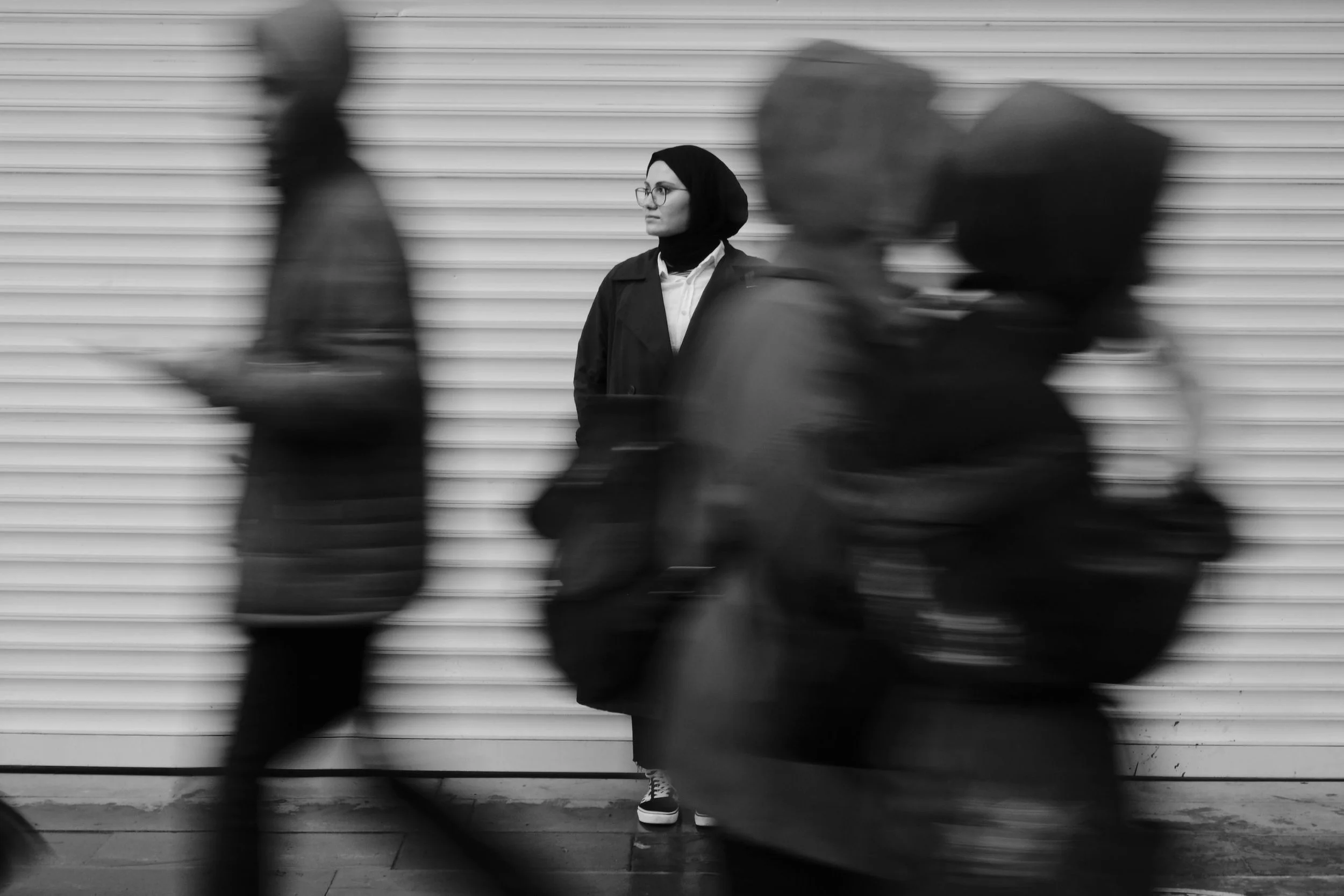
You are standing at the edge of a conversation in the student center. You know two of the people. You have a sentence ready, something easy about the assignment, and you have been rehearsing it for the last forty seconds while the conversation moves on without you. By the time you are ready to say it, the moment is gone, and you pick up your bag as if you had somewhere to be.
Social anxiety is not shyness. Shyness is a personality trait that can be perfectly comfortable. Social anxiety is wanting social connection and being significantly stopped by fear in the pursuit of it: fear of saying the wrong thing, of being judged, of standing out, of being rejected. For Muslim students at university, it tends to have specific dimensions that make it both more common and more complicated than it is for many of their peers.
At Salam Space, we work with Muslim students who are not introverted by nature but who have found the specific social landscape of university difficult to navigate. This post is about what is going on, and what helps.
Why University Is a Particularly Triggering Environment for Social Anxiety
University tends to intensify social anxiety for reasons that apply to all students: it involves an entirely new social environment, with an unfamiliar set of social codes, as an adult who is supposed to be capable of handling this independently. The first year in particular is saturated with high-stakes social moments, orientation events, first tutorials, forming study groups, trying to make friends, all in a context where everyone else appears to be doing it effortlessly.
That appearance of effortlessness is largely an illusion. Most students are more anxious about the social side of university than they let on. But social anxiety involves taking that appearance seriously and measuring your internal experience of anxiety against other people's external presentation of ease, which always produces an unflattering comparison.
For Muslim students, several specific factors amplify this general dynamic.
BOOK A SESSION
Ready to take the first step?
Confidential, culturally sensitive therapy — available online.
The Muslim-Specific Dimensions of University Social Anxiety
Managing non-Muslim social norms. University social life involves norms many Muslim students have not had to navigate before: the casual assumption that everyone drinks, the way events are centered on settings that conflict with Islamic practice, and the ongoing work of handling non-Muslim peers' sometimes intrusive curiosity about Muslim life. Each of these requires a kind of ongoing social negotiation that adds cognitive and emotional load to every interaction.
The fear of misrepresenting Islam. Many Muslim students carry a felt responsibility to represent their faith well, and that responsibility can add another layer to social anxiety: the worry that a social mistake is not just personally embarrassing, but somehow damaging to how Islam is perceived.
Navigating visible faith markers. For students who wear hijab or have other visible markers of their Muslim identity, these function as social information before they have said a word. Some people respond with real curiosity, some with awkwardness, and some with hostility. Navigating that range of responses while also trying to form genuine connections adds complexity that is real and exhausting.
Cross-cultural friendship dynamics. Many Muslim students are forming close friendships across cultural lines for the first time. The social scripts that work in their home culture do not always map onto university life. That gap requires more active social work, and the uncertainty can feed anxiety.
Anxiety within Muslim communities too. MSAs and Muslim social groups have their own social dynamics, hierarchies, and in-group norms. For students who do not fit the dominant culture of these groups, finding a social home within the Muslim community can be as anxiety-producing as finding one in the wider student population.
Also read: Everyone Around You Is Questioning Everything. What Happens to Your Faith?
When Social Anxiety Becomes Avoidance
The central feature of social anxiety that makes it self-perpetuating is avoidance. Social situations produce anxiety, so they are avoided. Avoidance reduces the anxiety in the short term but prevents social confidence and connection from developing in the longer term. Over time, the situations that trigger anxiety expand, the avoidance expands with them, and the student ends up increasingly isolated, which produces its own mental health consequences separate from the anxiety itself.
For Muslim students, avoidance tends to take specific forms. Some avoid non-Muslim social events entirely, framing this as a religious choice when it is also, partly, an anxiety management strategy. Some attend MSA events but stay on the periphery. Some become very social online while remaining physically isolated on campus. None of these patterns is inherently wrong, but when they are driven primarily by anxiety rather than genuine preference, they tend to compound the underlying problem instead of resolving it.
What this looks like in a single day is often small and easy to miss. It is the seat at the back of the lecture hall, the question you never ask, the message you type and delete, the meal you eat alone because joining a table felt impossible. None of it looks dramatic from the outside. But added together, over weeks and months, it shapes a student's whole experience of university, and the person starts to believe that this is simply who they are.
What Social Anxiety Is Not
Social anxiety is often confused with introversion or shyness, and this can lead students to accept their difficulty with social connection as just how they are, rather than as something that can be treated.
The key distinction is whether the social situation produces anxiety and discomfort before, during, and often after the fact, or whether you simply prefer quieter contexts. Introversion is a preference for less stimulating social environments. Social anxiety is a fear response to social evaluation that causes real impairment.
Most Muslim students who struggle socially at university are not introverts who would prefer to be alone. They are people who want connection and are being stopped from reaching for it by anxiety. That distinction matters, because social anxiety has well-established treatment in a way that introversion does not need.
What Islam Offers for Social Anxiety
Islam is deeply communal by nature. The emphasis on the ummah, on maintaining ties of kinship and friendship, on the collective nature of worship, and on the rights Muslims have over one another all point toward a tradition that values social connection.
The Quran describes the Prophet's gentleness as central to why people gathered around him: "It is out of Allah's mercy that you have been lenient with them. Had you been cruel or hard-hearted, they would have certainly abandoned you" (Quran 3:159). And the Prophet, peace be upon him, taught that no good deed is too small, not even meeting your brother with a cheerful face (Sahih Muslim 2626). Warmth in a small encounter is not a trivial social skill in this tradition. It is counted as good.
For Muslim students with social anxiety, connecting social development to this tradition, understanding that building genuine connection is part of religious life and not just a personal preference, can be motivating in a way that generic social skills advice is not. It can also be a relief: the goal is not to become the loudest person in the room, but to meet people with warmth, one small encounter at a time.
How Therapy Helps with Social Anxiety
Social anxiety is one of the conditions for which evidence-based therapy has a strong track record. The UK's National Institute for Health and Care Excellence (NICE) recommends cognitive behavioral therapy designed specifically for social anxiety as the first treatment to be offered, usually one-to-one, with up to 14 to 16 sessions over about four months. The therapeutic work involves several specific elements.
Identifying and challenging the beliefs driving the anxiety. Social anxiety is typically powered by beliefs about social evaluation: "they will think I am stupid," "I will say something embarrassing," "everyone will notice I am nervous." These beliefs are usually more negative than the evidence supports, and examining them carefully is a central part of the work.
Graduated exposure. The treatment for anxiety is not simply telling someone to relax. It involves gradually and deliberately engaging with the situations that produce anxiety, starting with easier ones and building toward harder ones, while developing the tolerance for discomfort that allows anxiety to reduce over time.
Understanding the Muslim-specific dimensions. A faith-informed therapist can help a Muslim student distinguish between the genuine religious navigation that university social life requires and the anxiety-driven avoidance that is limiting their social world beyond what their faith actually asks of them.
Addressing post-event processing. People with social anxiety tend to replay social interactions afterward, focusing on everything that went wrong. This prolongs the anxiety and makes each future situation feel higher stakes. Therapy specifically addresses this pattern.
Building on Islamic social values. Connecting the therapeutic work to Islamic concepts of community, warmth, and the rights of others over each other can give Muslim students a framework for their social development that feels meaningful and not just a way of managing anxiety.
There are also small things you can begin before you ever book a session. Pick one low-stakes interaction a day, such as saying salaam to someone you pass regularly or asking a classmate how they found the reading, and treat it as an experiment rather than a test. Notice what you predicted would happen and what actually happened.
Most people with social anxiety discover that the reaction they feared is far rarer, and far milder, than the one their mind rehearsed. That small gap between prediction and reality is exactly what therapy builds on, with more structure and support.
READY TO FEEL UNDERSTOOD?
Faith-centered therapy, personalized for your journey.
You Are Allowed to Want Connection
Social anxiety in Muslim college students is extremely common, significantly impairing, and treatable. If you are spending significant energy wanting to connect but being consistently stopped by fear, that is not just how you are. It is a recognizable pattern with evidence-based treatment.
You deserve to find genuine connection at university. That is both a human need and, in Islamic terms, part of how a healthy communal life is built. Therapy can help you get there.
Salam Space works with Muslim students navigating social anxiety in all its forms.
Frequently Asked Questions
Is social anxiety the same as being an introvert?
No. Introversion is a preference for less stimulating social environments and does not necessarily involve anxiety. Social anxiety is a fear response to social evaluation that causes real distress and impairment, regardless of whether the person is introverted or extroverted by nature.
My social anxiety seems worse at university than it was at school. Why?
University involves navigating an entirely new social environment with unfamiliar codes, as an adult who is expected to manage it independently. That is a much more demanding social context than school, and it commonly intensifies pre-existing social anxiety.
Can social anxiety be treated without medication?
Yes. NICE recommends a form of CBT designed for social anxiety as the first treatment, and medication is considered for people who prefer it or who do not want CBT. For some people, medication is also helpful alongside therapy, and that is a decision to make with a healthcare professional.
Will therapy for social anxiety push me into situations that go against my religion?
No, and it is worth asking this directly at the start. Exposure in CBT is built around your own goals and your own values, and a good therapist will not ask you to enter settings that conflict with your faith. In practice, the exposure is usually something like starting a conversation after class, speaking up in a seminar, or joining a study group, and not attending events that conflict with your religion. A faith-informed therapist can help you tell the difference between situations you avoid because of your faith and situations you avoid because of fear, and only work on the second kind.
I avoid social situations and tell myself it is because I am a practicing Muslim, but I am not sure. How do I know?
If you genuinely prefer quieter contexts and feel content with your current level of social connection, that is one thing. If you are avoiding situations and feeling lonely, resentful, or restricted as a result, that suggests avoidance is playing a role alongside or instead of genuine religious preference.
How do I decline an invitation without it feeling awkward?
Keep it short, warm, and specific, and you do not owe a long explanation. Something like "Thanks so much for the invite, that is not really my kind of event, but I would love to get coffee this week" does two things: it declines without apology, and it offers a way to still connect. Over-explaining usually makes it feel more awkward, not less. If you notice that you decline everything, or that saying no leaves you feeling relieved and then lonely, that pattern is worth talking through with a therapist.
Can a faith-informed therapist help with social skills specifically?
Yes. Social skill development, including conversation skills, reading social cues, and building the confidence to start and sustain relationships, is something therapy can address directly and practically.
How long does therapy for social anxiety usually take?
It varies with severity and with how consistently you practice between sessions. For reference, NICE's guidance describes up to 14 to 16 sessions of CBT over about four months, though some people need fewer and others more.
