
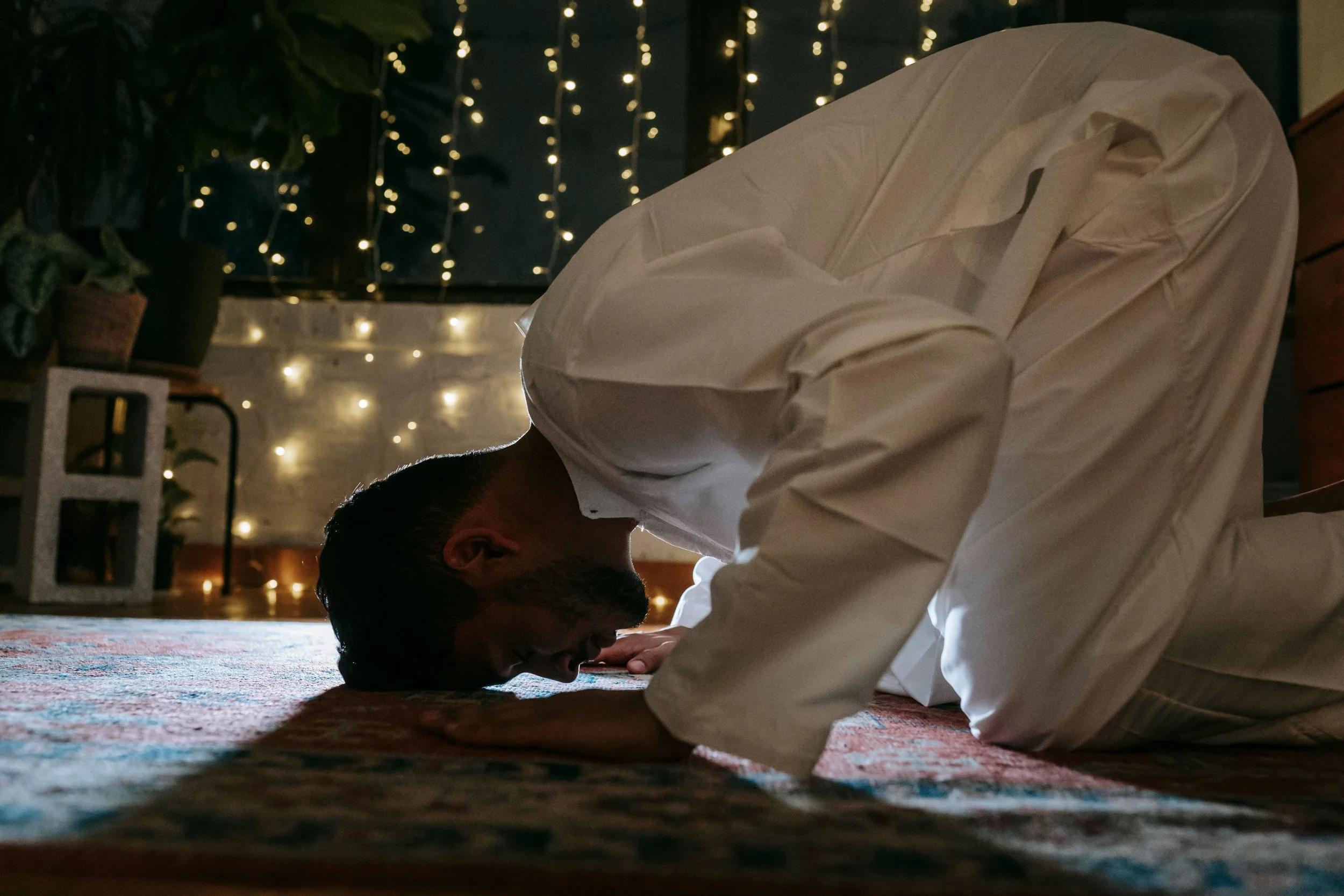
You just finished your fifth prayer of the day. You fasted, you read Quran, you made dhikr between tasks. And somewhere underneath all of it sits a quiet, familiar verdict: still not enough.
At Salam Space, we talk to Muslims caught in exactly this loop, people whose effort is real and consistent, and who still cannot find the peace that effort is supposed to produce. This post is about understanding why that happens, and finding a way out of it.
Ihsan and Perfectionism Are NOT the Same Thing
Islam genuinely encourages excellence. The concept of ihsan, doing things in the most excellent way possible, with full awareness that Allah sees everything, is central to Islamic spirituality. The Prophet Muhammad, peace be upon him, described ihsan as worshipping Allah as though you can see Him, knowing that He certainly sees you.
This is genuinely beautiful, and for many people it is motivating in a healthy way. But Shams Islamic Psychology notes that perfectionism is not the same as ihsan, and is in fact a symptom of internal imbalance, one that can lead to guilt, shame, spiritual fatigue, and even a sense of estrangement from Allah.
The difference is not in the outward actions, which might look identical. The difference is in what is driving those actions, and what happens internally when they fall short. Ihsan is oriented toward Allah, with humility about one's own limitations built in. Religious perfectionism is oriented toward an internal, often punishing, standard that treats any falling short as evidence of failure, sometimes as evidence of being a fundamentally inadequate Muslim.
What Religious Perfectionism Actually Looks Like
Religious perfectionism can show up in a range of ways, some obvious, some much quieter. What makes it hard to catch is that, from the outside, and often from the inside too at first, every one of these can look like simple diligence, the ordinary effort of someone who takes their faith seriously.
The prayer that is never quite right. Repeating prayers, recitations, or specific movements because of a persistent feeling that the previous attempt was not done correctly, sincerely, or with sufficient focus, even when there is no actual error.
Guilt that does not resolve. Feeling guilty about a sin long after sincere repentance, repeatedly, as though the forgiveness Islam describes does not quite apply in this particular case.
All-or-nothing religious practice. A single missed prayer or a moment of impatience experienced not as a normal part of human inconsistency, but as evidence that the whole effort has been undermined.
Comparing your inner state to other people's outer practice. Looking at someone else's apparent religious consistency and concluding that they must have an inner peace and certainty that you do not have.
Spiritual fatigue. A sense of exhaustion around religious practice itself, where things that are meant to bring comfort, prayer, dhikr, reading Quran, start to feel like one more area where you might be falling short.
If your relationship with worship has become a source of anxiety rather than comfort, that is worth talking about. Salam Space offers a space to explore this with care for both your wellbeing and your faith.
BOOK A SESSION
Ready to take the first step?
Confidential, culturally sensitive therapy — available online.
Where This Often Comes From
Religious perfectionism rarely comes from nowhere. Shams Islamic Psychology describes how perfectionism can arise from psychological wounds, conditional love, harsh criticism, or early experiences that taught someone 'I have to be perfect to be loved or safe,' which then becomes attached to religious practice as the arena where that belief plays out.
For many people, this connects to how religious practice was modelled or enforced during childhood. A household where mistakes in prayer or recitation were met with harsh correction, where religious observance was tied to approval or disapproval, or where Allah was primarily presented as a figure of judgement rather than mercy, can shape a relationship with faith that carries this same tone into adulthood.
Community dynamics play a role too. In environments where religious knowledge or practice becomes a kind of social currency, the pressure to perform religiosity correctly can become its own source of anxiety.
None of this means the household or the community intended harm. Most of the time, the correction was meant as love, a parent genuinely wanting a child to grow up practicing well, a teacher genuinely wanting a student to take worship seriously. The outcome can still be the same internal message, regardless of the intention behind it: that love and safety are conditional on getting the religious performance right. Naming where the pattern came from is not about assigning blame. It is about understanding why a particular standard feels so non-negotiable now, so that it can finally be examined rather than simply obeyed.
The Khawf and Raja Imbalance
Islamic spirituality describes a healthy balance between khawf, fear, and raja, hope. Religious perfectionism is, in many ways, a specific expression of this same imbalance, where fear of falling short dominates so completely that hope becomes almost inaccessible.
This imbalance is not a new observation. Al-Ghazali devotes a book of his Ihya Ulum al-Din to muraqaba and muhasaba, vigilance and self-examination, warning against exactly the kind of scrupulous, self-punishing doubt this pattern describes. Ibn Qayyim al-Jawziyya's Madarij al-Salikin maps the entire spiritual path through named stations, with khawf and raja among the central ones, precisely because a soul can lose its footing by leaning too far into either one. Centuries before the language of anxiety and perfectionism existed, these scholars were already describing a disconnect between the form of worship and its substance.
This is worth sitting with directly: if your religious practice consistently produces anxiety rather than any sense of connection or relief, even occasionally, that is not a sign that you need to try harder. It is a sign that something in how this practice is being experienced has become disconnected from its purpose.
A Script for the Moment Doubt Hits
Knowing this intellectually rarely helps in the actual moment a doubt shows up, mid-wudu, mid-prayer, right after saying something you're now not sure you meant sincerely enough. The instinct is to go back and redo it. That instinct is usually the problem, not the solution.
The guidance from scholars and clinicians who work with this pattern specifically points the same direction: finish the act, treat it as valid, and deliberately do not go back, while turning to a short, specific dhikr instead of reasoning with the doubt. A simple internal line can do the work a long internal argument cannot: "I did this with the intention I had. It counts. I am not going back." Said once, and then moving on, even while the discomfort is still there, is itself the practice that eventually weakens the pattern.
This will feel counterintuitive the first several times, because the doubt will insist that this one time is different, that this specific prayer really might be invalid. It rarely is. The pattern itself is the thing to treat with suspicion, not the validity of the act you just completed. Practicing this response deliberately, even when it feels wrong in the moment, is what gradually teaches the anxious part of the mind that nothing catastrophic happens when the ritual is not repeated.
What Allah Actually Asks For
The Quran describes Allah as not burdening a soul beyond its capacity (Surah Al-Baqarah, 2:286). The Prophet Muhammad, peace be upon him, taught that the religion is easy, and whoever overburdens himself in his religion will not be able to continue. He also taught that the deeds most beloved to Allah are not the most numerous or the most intense, but the most consistent, even if small.
Allah's mercy is described throughout the Quran in terms that exceed human imagination. Sincere effort, imperfect as it inevitably will be, is what is asked for, not flawlessness. The gap between this picture and the internal experience of religious perfectionism is often significant, and naming that gap explicitly can be the beginning of real relief.
It is worth sitting with what this actually implies: a standard this merciful was not designed by accident, and the exhausting, never-enough version so many people carry instead did not come from the religion itself. Somewhere along the way, a much harsher standard got attached to it. Recognising that the two are not the same thing is not a small theological footnote. It is often the single shift that makes the rest of the work, in therapy or otherwise, possible at all.
How Therapy Helps
Therapy for religious perfectionism works with both the psychological patterns involved and the religious content they have attached themselves to, without treating either in isolation. Trying to address only the anxiety, without engaging the religious meaning underneath it, often leaves the spiritual guilt untouched. Trying to address only the religious question, without engaging the anxiety itself, often leaves someone with a correct answer that still does not bring relief. Working with both together is what tends to actually move something.
Identifying the underlying pattern. Often, religious perfectionism is one expression of a broader perfectionism that shows up in other areas of life too. Recognising this can help separate 'this is how anxiety operates for me' from 'this is what my faith demands.'
Exploring where the standard came from. Gently examining the origins of the internal standard being used, whether from childhood experiences, community dynamics, or specific teachings encountered along the way.
Reconnecting form with substance. Working on practical ways to experience worship as connection rather than performance.
Building tolerance for imperfection. Practising, often gradually and with discomfort at first, the experience of an imperfect prayer or an off day, without the catastrophic interpretation that perfectionism attaches to these moments.
Rebuilding a relationship with mercy. Working toward a felt sense, not just an intellectual understanding, of the mercy that Islamic teaching describes as central to Allah's relationship with believers.
Faith-informed talk therapy at Salam Space is available virtually anywhere in Texas, or in person in Austin or Houston, whichever feels more comfortable to start with. .
READY TO FEEL UNDERSTOOD?
Faith-centered therapy, personalized for your journey.
Worship Was Never Meant to Feel Like a Performance Review
Religious perfectionism among Muslims is often invisible because it looks identical to devotion from the outside. But a faith that consistently produces anxiety, guilt that does not resolve, and a sense of never being enough is not functioning the way Islam describes faith as functioning.
Ihsan, doing things well because Allah sees you, is an invitation into presence and care. Perfectionism is a trap that mimics that invitation while delivering something much harsher. If this has been your experience, it is a sign that something has become disconnected, not that you have failed, and it can be reconnected.
You do not have to keep trying harder at a version of faith that was never asking that of you in the first place. The effort you have already been putting in, the five prayers, the fasting, the dhikr between tasks, was never the problem. What it was attached to might be.
Salam Space is here to help you find your way back to a faith that feels like rest.
Frequently Asked Questions
Is it bad to want to do everything perfectly in my religious practice?
Wanting to do things well is not the issue. The issue is when that desire produces constant anxiety, guilt that does not resolve, or a sense that nothing is ever enough. That experience is different from ihsan, even if the outward actions look the same.
How do I know if I have religious perfectionism or if I am just not religious enough?
Religious perfectionism often shows up as anxiety and guilt that persist regardless of how much effort is made, with no sense of relief even after sincere practice. If more effort never produces peace, that is a signal worth paying attention to.
Will therapy try to make me less religious?
No. Faith-informed therapy at Salam Space works within your beliefs, helping address the anxiety and guilt patterns that have attached themselves to religious practice, not the practice itself.
I feel guilty even after sincere repentance. Is something wrong with my faith?
This is a recognised pattern, often connected to perfectionism or scrupulosity, rather than a reflection of your faith being insufficient. Persistent guilt despite sincere repentance is something therapy can help with.
Is there a name for when this becomes more than just feeling anxious about worship?
Yes. When this pattern becomes severe, intrusive doubts about whether an act of worship was done correctly, repeated well beyond what the act requires, taking up significant time, and causing real distress, it has a specific name in Islamic psychology: waswasah, or waswas al-qahri. It is increasingly recognised in clinical literature as a religious presentation of obsessive-compulsive patterns, and it responds best to support that understands both the psychological side and the religious content involved, ideally a therapist and a knowledgeable religious source working with the same understanding of what is actually required, rather than either one working in isolation.
Can religious perfectionism affect other areas of my life too?
Often, yes. Perfectionism that shows up in religious practice frequently shows up in other areas as well, work, relationships, self-image. Addressing the underlying pattern can have benefits beyond the religious context specifically.
How can I start to feel more at peace during prayer?
This varies by person, but often involves working, gradually and with support, on tolerating imperfection in worship without catastrophic interpretation, and reconnecting with the sense of being seen with mercy rather than scrutiny. A faith-informed therapist can help you explore what this looks like for you specifically.
What can I actually do in the moment a doubt or urge to repeat hits?
Try to finish the act and let it stand, rather than going back to redo it, even though the urge to redo it will feel urgent. Turning to a short dhikr or seeking refuge in the moment, rather than mentally arguing with the doubt, tends to work better than trying to reason your way to certainty, since certainty is rarely what these doubts are actually asking for. If this is a frequent, daily struggle rather than an occasional one, that is worth bringing to a therapist directly rather than managing alone.
