
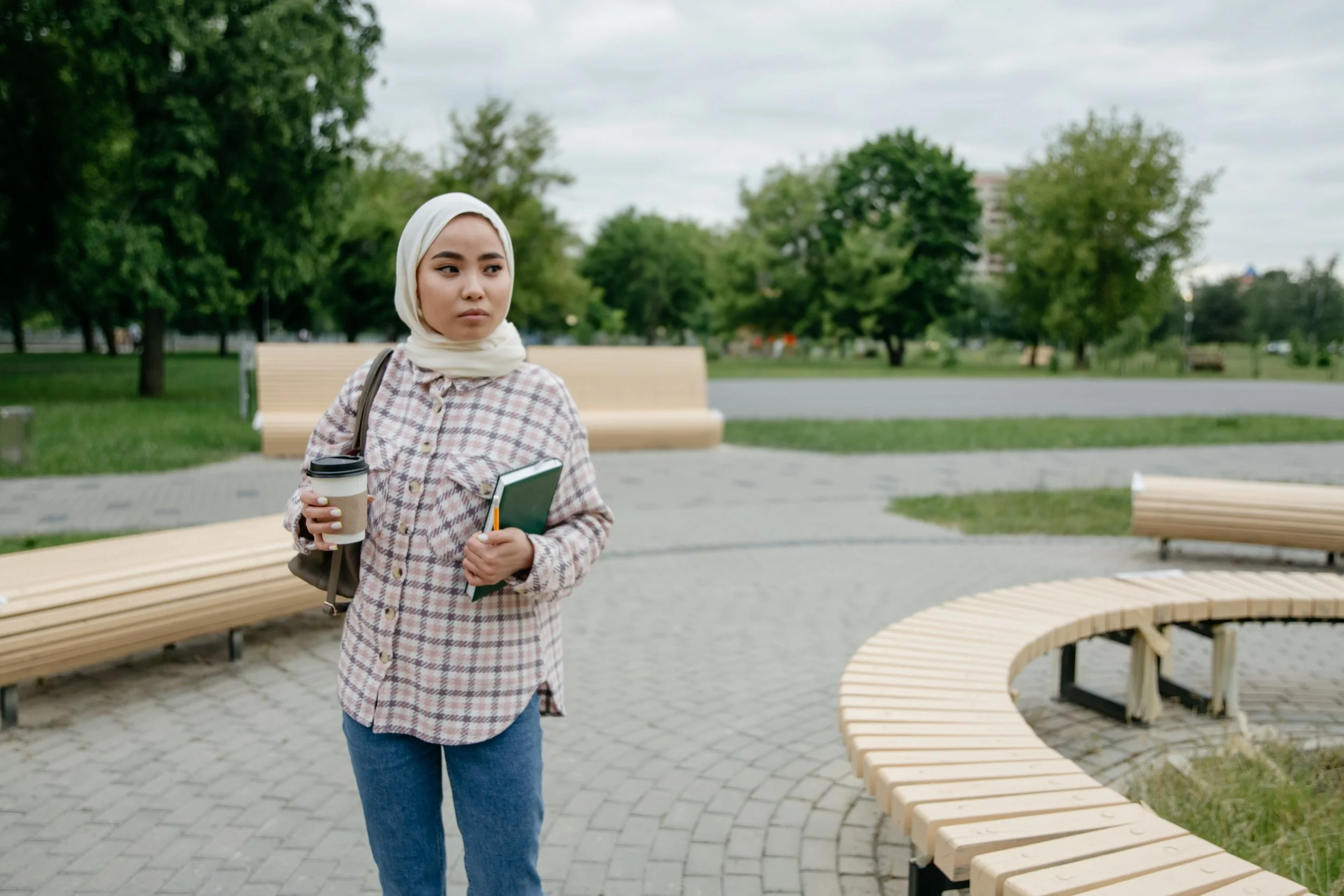
Your voice changes half a step on the walk from the lecture hall to the prayer room. A little quieter, a little more careful. By the time your mother calls, you have changed again. When you open Instagram, you are someone else once more.
None of it feels like lying. It feels like keeping four sets of keys on one ring and trying not to mix them up.
Code switching means adjusting your language, behavior, or presentation depending on who you are with. Everyone does this to some degree. But for some Muslim students, especially those navigating very different expectations at home, university, and within their communities, it can become exhausting.
At Salam Space, we work with Muslim students who carry that exhaustion without always realizing where it comes from.
What Code Switching Looks Like For Muslim Students
For Muslim students, code switching can mean moving between several versions of yourself in the same day:
| Context | The version you may feel expected to be |
|---|---|
| University | Academic, socially adaptable, and careful about how openly you express your Muslim identity. |
| Home | The responsible child who is doing well, staying out of trouble, praying, and meeting family expectations. |
| Mosque & community | The practicing Muslim who participates in religious life and may appear more certain or conservative than you feel internally. |
| Online | A curated version of yourself that may feel more confident, authentic, or simply more controlled. |
The problem is not having different sides of yourself. The exhausting part is constantly managing which side is allowed to show up. Over time, that can leave you monitoring your words, anticipating other people's reactions, and wondering where you can simply be yourself.
Moving Between Worlds Is a Skill. The Cost Is in the Effort.
It is worth saying first that moving between cultural worlds is not itself a sign of a problem. A meta-analysis by Nguyen and Benet-Martinez of 83 studies and more than 23,000 participants found that being comfortable in more than one culture was significantly associated with better psychological and sociocultural adjustment.
The issue is not having different ways of showing up. It is when adapting becomes so constant that it starts to feel like work. That can look like a persistent tiredness that does not seem proportionate to what you have been doing physically. A feeling of never quite relaxing, of always being slightly on guard. Difficulty identifying what you actually think or feel because so much mental energy goes into tracking what you are expected to think or feel in each context. And, sometimes, a creeping sense of fraudulence in every context, because none of the versions you present feels like the whole of who you are.
BOOK A SESSION
Ready to take the first step?
Confidential, culturally sensitive therapy — available online.
Why Muslim Students Develop This Pattern
Code switching on this scale does not develop randomly. It develops in response to real social pressures that have taught students, through experience, that different audiences require different versions of them.
The university environment may have signaled, through subtle or overt means, that full Muslim identity expression is unwelcome or will be met with awkward curiosity. The family may have signaled that certain kinds of honesty, about doubts, about social experiences, about who the student is becoming, will cause pain or conflict. The Muslim community may have signaled that anything other than visible, confident piety is a social risk.
The student who has learned to navigate all of these signals simultaneously has not done something wrong. They have done something adaptive. But the adaptation has a cost, and at some point the cost outweighs the protection that the code switching provides. The family version of this pattern, where a student performs the child their parents expect, is something we look at more closely in our post on parent conflict for Muslim students at university.
What Integrated Identity Actually Looks Like
The goal is not that Muslim students present identically in every context. Social context appropriately shapes how we present ourselves, and some degree of code switching is normal and healthy. The difference between healthy contextual adjustment and exhausting fragmentation is whether there is a core, a genuine sense of who you are that does not disappear depending on who is watching.
Integrated identity for a Muslim student might look like: being able to be Muslim at university without it feeling like a performance or a disclosure. Being able to be a full, complex person at home without managing the parental version of you so carefully that they do not know who you actually are. Being honest in the mosque community about where you are in your faith without it feeling like a risk. Finding the thread of continuity between all the different contexts you move through.
This is not something that happens by itself. It requires a process of deliberately examining each of the different versions you have developed, understanding what they were protecting you from, and deciding which protective adaptations are still necessary and which are simply habits that no longer serve you.
What Islam Says About Code Switching
Tawakkul, or trust in Allah, can offer a different way of thinking about code switching. If your worth ultimately comes from Allah, you do not have to constantly manage how every person sees you. The Quran emphasizes sincere devotion to Allah (Quran 98:5), but sincerity does not mean telling everyone everything about yourself.
Adapting how you communicate is not inherently wrong either. The Quran tells us that Allah sent each messenger in the language of his people (Quran 14:4). Changing your words, tone, or level of detail depending on who you are speaking to is a normal part of communication.
Some students worry that this makes code switching the same as being “two-faced.” The hadith about double-faced people (Sahih al-Bukhari 6058) is referring to deliberately presenting different loyalties to different groups, not simply adjusting how you express yourself in different settings. If this distinction is causing you religious anxiety, it is worth discussing your specific situation with a knowledgeable scholar.
The goal is not to become exactly the same in every room. It is to feel that the person underneath those different versions is still you.
How Therapy Helps
Making the fragmentation visible. Many students who are code switching extensively have never named it as such, because they have been doing it for so long it feels normal. Therapy creates space to notice the pattern explicitly, which is the first step to addressing it.
Identifying what each version is protecting. Each of the versions a student presents was developed for a reason. Understanding that reason, without judgment, allows for a more considered evaluation of whether the protection is still necessary or whether it has outlived its usefulness.
Building a more integrated sense of self. The core work of therapy for code switching is the construction of a more stable, integrated identity that can navigate different contexts without disappearing in any of them. This is slow work that requires honesty and trust.
Reducing the fear of other people's reactions. Much of the code switching is driven by anticipation of how different audiences will respond to different aspects of the student's identity. Developing a more realistic and less catastrophic assessment of those responses tends to reduce the need for extensive management.
Finding language for the whole of who you are. Many students who have been code switching for years have genuinely lost touch with the full picture of who they are. Therapy provides space to find, develop and articulate that picture.
Faith-informed talk therapy at Salam Space is available virtually anywhere in Texas, or in person in Austin or Houston, whichever feels more comfortable to start with. And if cost or insurance coverage is part of what has been holding you back, Salam Space works with most major insurance plans and is upfront about pricing before you ever book, so the team can help you check your coverage before your first session.
READY TO FEEL UNDERSTOOD?
Faith-centered therapy, personalized for your journey.
You Do Not Need Four Selves
The exhaustion of being a different person in every room is real, and it tends to accumulate quietly until it becomes significant. Muslim students who have spent years calibrating their presentation to every audience deserve a space where none of that calibration is necessary, where they can simply be whoever they actually are.
That space is part of what therapy at its best provides. And from that space, the work of building a more integrated identity becomes possible.
Salam Space is here.
Frequently Asked Questions
Is code switching something I should be trying to stop entirely?
No. Some contextual adjustment in how you present yourself is normal and healthy, and research suggests that being comfortable in more than one cultural world is linked to better adjustment, not worse. The concern is when the fragmentation between versions is so significant that there is no stable core, and when the management of different versions is producing significant exhaustion.
I have been code switching for so long I do not know who I actually am. Is that fixable?
Yes. Reconnecting with a more integrated sense of self is one of the core goals of identity-focused therapy, and it is possible even after years of extensive code switching.
Does code switching mean I am being dishonest?
Not necessarily. There is a difference between contextual adjustment and deception. The question is whether you are presenting different aspects of yourself in different contexts or presenting fundamentally different selves in ways that are not consistent with any core identity, and whether anyone is being misled to their harm.
Is code switching haram?
We are not scholars, and we cannot give a ruling. What we can say is that the Quran itself describes messengers speaking in the language of their people (Quran 14:4), and that the verse often cited in this context, Quran 2:14, concerns people who pretend to believe while mocking believers privately, which is very different from a sincere Muslim choosing how much to share in different settings. If you are worried about a specific situation, ask a knowledgeable scholar. The exhaustion the pattern produces is worth addressing either way.
My family does not know who I actually am. How do I start to change that?
This is one of the most common and delicate therapeutic goals. There is no single answer, but therapy can help you identify what you want your family to know, what risks that involves, and how to approach the conversation when you are ready.
Can therapy help me feel more comfortable being Muslim at university?
Yes. Therapy can help you develop a more stable and internally held Muslim identity that does not require constant management of others' perceptions, and that can navigate the university environment with more ease.
What if the mosque or Muslim community is where I feel most judged?
This is more common than people admit. Communities can carry strong expectations about how a "good Muslim" looks, and a student who is doubting or struggling may feel they cannot be honest there. It may help to find one or two people in the community with whom you can be more honest before trying to be honest with everyone, and to remember that a community is made of individuals, some of whom are more understanding than the loudest voices. If the judgment is affecting your faith or your mood, a faith-informed therapist at Salam Space can help you sort out what is cultural expectation, what is your own, and how you want to relate to the community.
I am visibly Muslim and cannot hide it. Does code switching still apply to me?
Yes, in a different way. When your identity is visible, you may not be able to choose whether to show it, but you still adjust how much you say, what you explain and how you respond to questions.
